EX-99.1
Published on March 26, 2026
Palmetto HASI Holdings LLC and Subsidiaries Consolidated Financial Statements December 31, 2025 and 2024
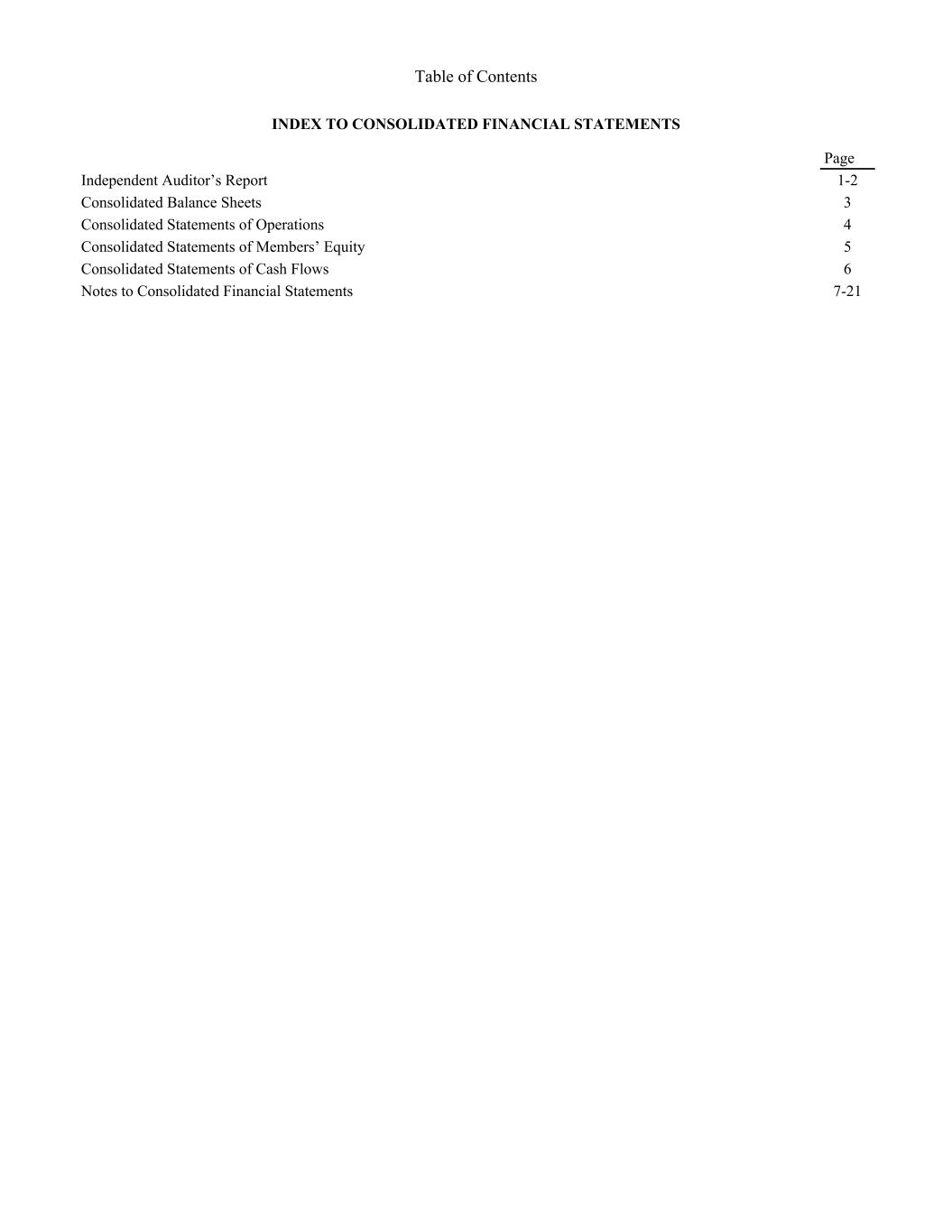
Table of Contents INDEX TO CONSOLIDATED FINANCIAL STATEMENTS Page Independent Auditor’s Report 1-2 Consolidated Balance Sheets 3 Consolidated Statements of Operations 4 Consolidated Statements of Members’ Equity 5 Consolidated Statements of Cash Flows 6 Notes to Consolidated Financial Statements 7-21
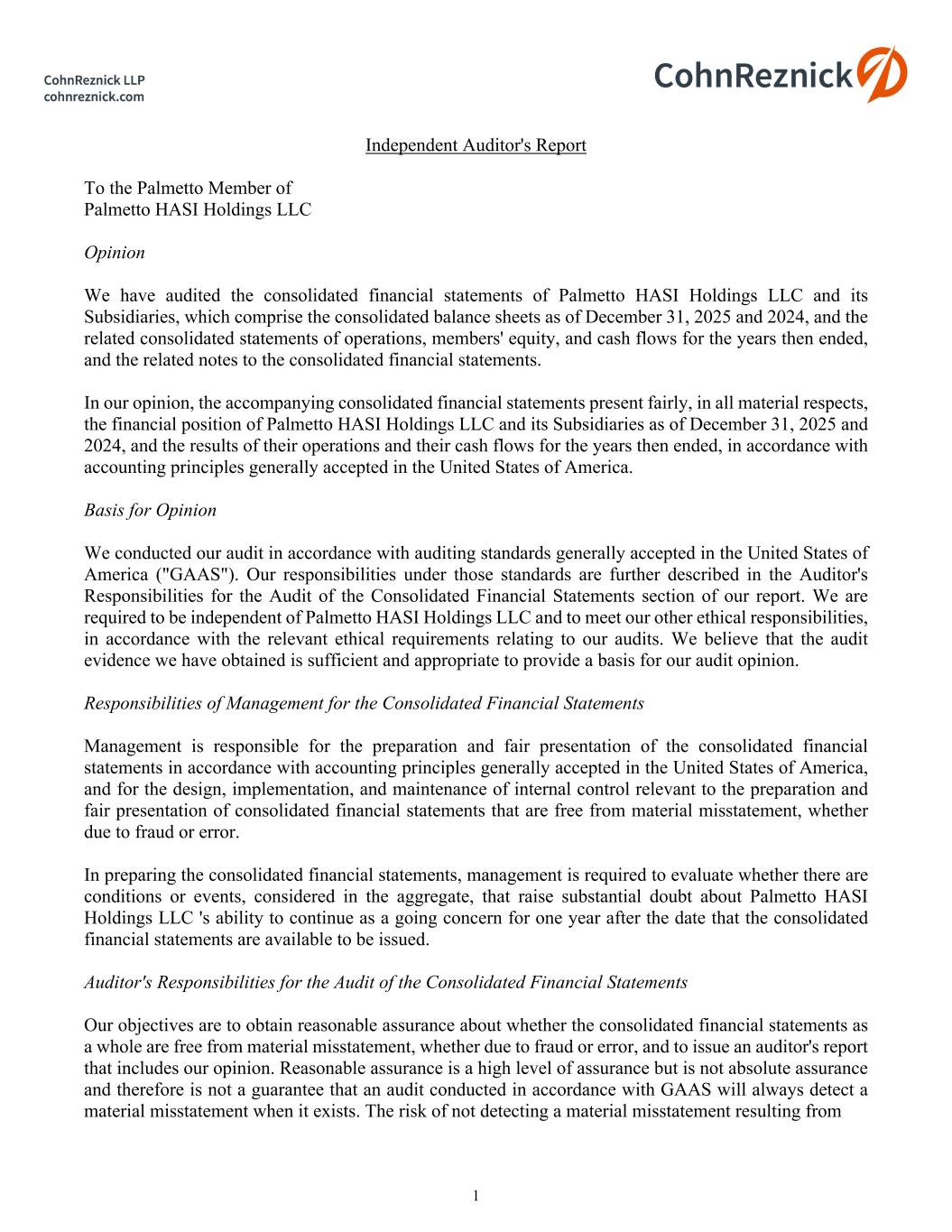
1 Independent Auditor's Report To the Palmetto Member of Palmetto HASI Holdings LLC Opinion We have audited the consolidated financial statements of Palmetto HASI Holdings LLC and its Subsidiaries, which comprise the consolidated balance sheets as of December 31, 2025 and 2024, and the related consolidated statements of operations, members' equity, and cash flows for the years then ended, and the related notes to the consolidated financial statements. In our opinion, the accompanying consolidated financial statements present fairly, in all material respects, the financial position of Palmetto HASI Holdings LLC and its Subsidiaries as of December 31, 2025 and 2024, and the results of their operations and their cash flows for the years then ended, in accordance with accounting principles generally accepted in the United States of America. Basis for Opinion We conducted our audit in accordance with auditing standards generally accepted in the United States of America ("GAAS"). Our responsibilities under those standards are further described in the Auditor's Responsibilities for the Audit of the Consolidated Financial Statements section of our report. We are required to be independent of Palmetto HASI Holdings LLC and to meet our other ethical responsibilities, in accordance with the relevant ethical requirements relating to our audits. We believe that the audit evidence we have obtained is sufficient and appropriate to provide a basis for our audit opinion. Responsibilities of Management for the Consolidated Financial Statements Management is responsible for the preparation and fair presentation of the consolidated financial statements in accordance with accounting principles generally accepted in the United States of America, and for the design, implementation, and maintenance of internal control relevant to the preparation and fair presentation of consolidated financial statements that are free from material misstatement, whether due to fraud or error. In preparing the consolidated financial statements, management is required to evaluate whether there are conditions or events, considered in the aggregate, that raise substantial doubt about Palmetto HASI Holdings LLC 's ability to continue as a going concern for one year after the date that the consolidated financial statements are available to be issued. Auditor's Responsibilities for the Audit of the Consolidated Financial Statements Our objectives are to obtain reasonable assurance about whether the consolidated financial statements as a whole are free from material misstatement, whether due to fraud or error, and to issue an auditor's report that includes our opinion. Reasonable assurance is a high level of assurance but is not absolute assurance and therefore is not a guarantee that an audit conducted in accordance with GAAS will always detect a material misstatement when it exists. The risk of not detecting a material misstatement resulting from
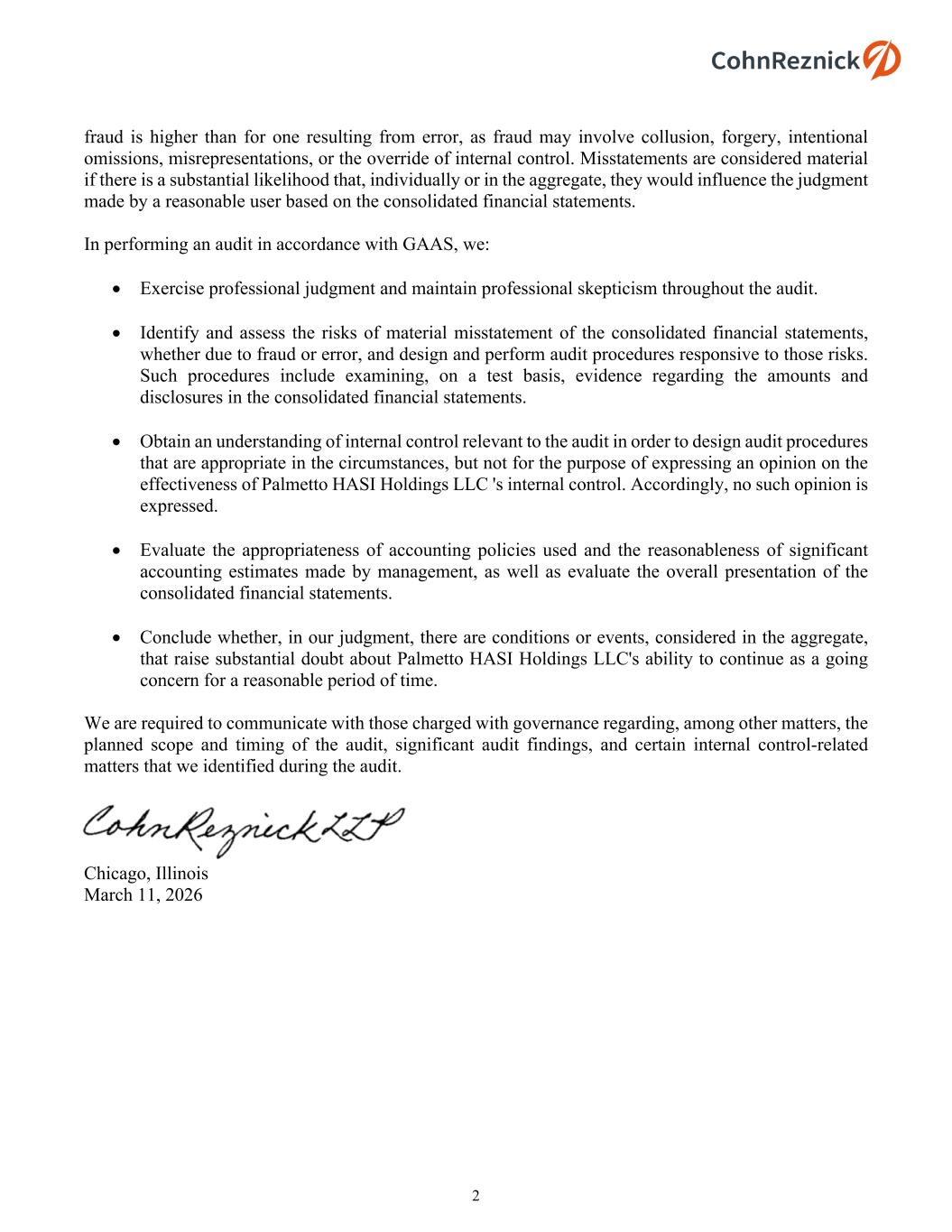
2 fraud is higher than for one resulting from error, as fraud may involve collusion, forgery, intentional omissions, misrepresentations, or the override of internal control. Misstatements are considered material if there is a substantial likelihood that, individually or in the aggregate, they would influence the judgment made by a reasonable user based on the consolidated financial statements. In performing an audit in accordance with GAAS, we: Exercise professional judgment and maintain professional skepticism throughout the audit. Identify and assess the risks of material misstatement of the consolidated financial statements, whether due to fraud or error, and design and perform audit procedures responsive to those risks. Such procedures include examining, on a test basis, evidence regarding the amounts and disclosures in the consolidated financial statements. Obtain an understanding of internal control relevant to the audit in order to design audit procedures that are appropriate in the circumstances, but not for the purpose of expressing an opinion on the effectiveness of Palmetto HASI Holdings LLC 's internal control. Accordingly, no such opinion is expressed. Evaluate the appropriateness of accounting policies used and the reasonableness of significant accounting estimates made by management, as well as evaluate the overall presentation of the consolidated financial statements. Conclude whether, in our judgment, there are conditions or events, considered in the aggregate, that raise substantial doubt about Palmetto HASI Holdings LLC's ability to continue as a going concern for a reasonable period of time. We are required to communicate with those charged with governance regarding, among other matters, the planned scope and timing of the audit, significant audit findings, and certain internal control-related matters that we identified during the audit. Chicago, Illinois March 11, 2026
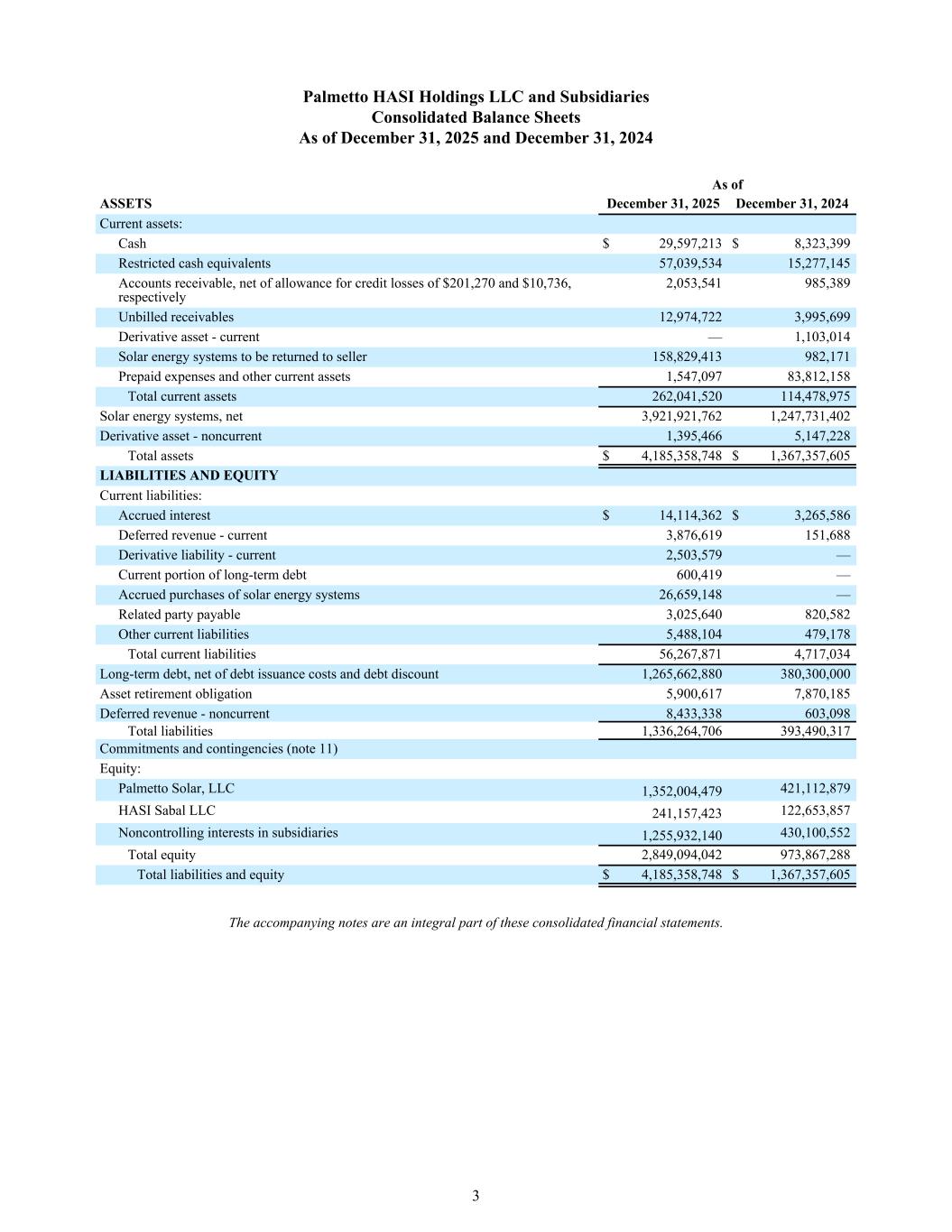
Palmetto HASI Holdings LLC and Subsidiaries Consolidated Balance Sheets As of December 31, 2025 and December 31, 2024 As of ASSETS December 31, 2025 December 31, 2024 Current assets: Cash $ 29,597,213 $ 8,323,399 Restricted cash equivalents 57,039,534 15,277,145 Accounts receivable, net of allowance for credit losses of $201,270 and $10,736, respectively 2,053,541 985,389 Unbilled receivables 12,974,722 3,995,699 Derivative asset - current — 1,103,014 Solar energy systems to be returned to seller 158,829,413 982,171 Prepaid expenses and other current assets 1,547,097 83,812,158 Total current assets 262,041,520 114,478,975 Solar energy systems, net 3,921,921,762 1,247,731,402 Derivative asset - noncurrent 1,395,466 5,147,228 Total assets $ 4,185,358,748 $ 1,367,357,605 LIABILITIES AND EQUITY Current liabilities: Accrued interest $ 14,114,362 $ 3,265,586 Deferred revenue - current 3,876,619 151,688 Derivative liability - current 2,503,579 — Current portion of long-term debt 600,419 — Accrued purchases of solar energy systems 26,659,148 — Related party payable 3,025,640 820,582 Other current liabilities 5,488,104 479,178 Total current liabilities 56,267,871 4,717,034 Long-term debt, net of debt issuance costs and debt discount 1,265,662,880 380,300,000 Asset retirement obligation 5,900,617 7,870,185 Deferred revenue - noncurrent 8,433,338 603,098 Total liabilities 1,336,264,706 393,490,317 Commitments and contingencies (note 11) Equity: Palmetto Solar, LLC 1,352,004,479 421,112,879 HASI Sabal LLC 241,157,423 122,653,857 Noncontrolling interests in subsidiaries 1,255,932,140 430,100,552 Total equity 2,849,094,042 973,867,288 Total liabilities and equity $ 4,185,358,748 $ 1,367,357,605 The accompanying notes are an integral part of these consolidated financial statements. 3
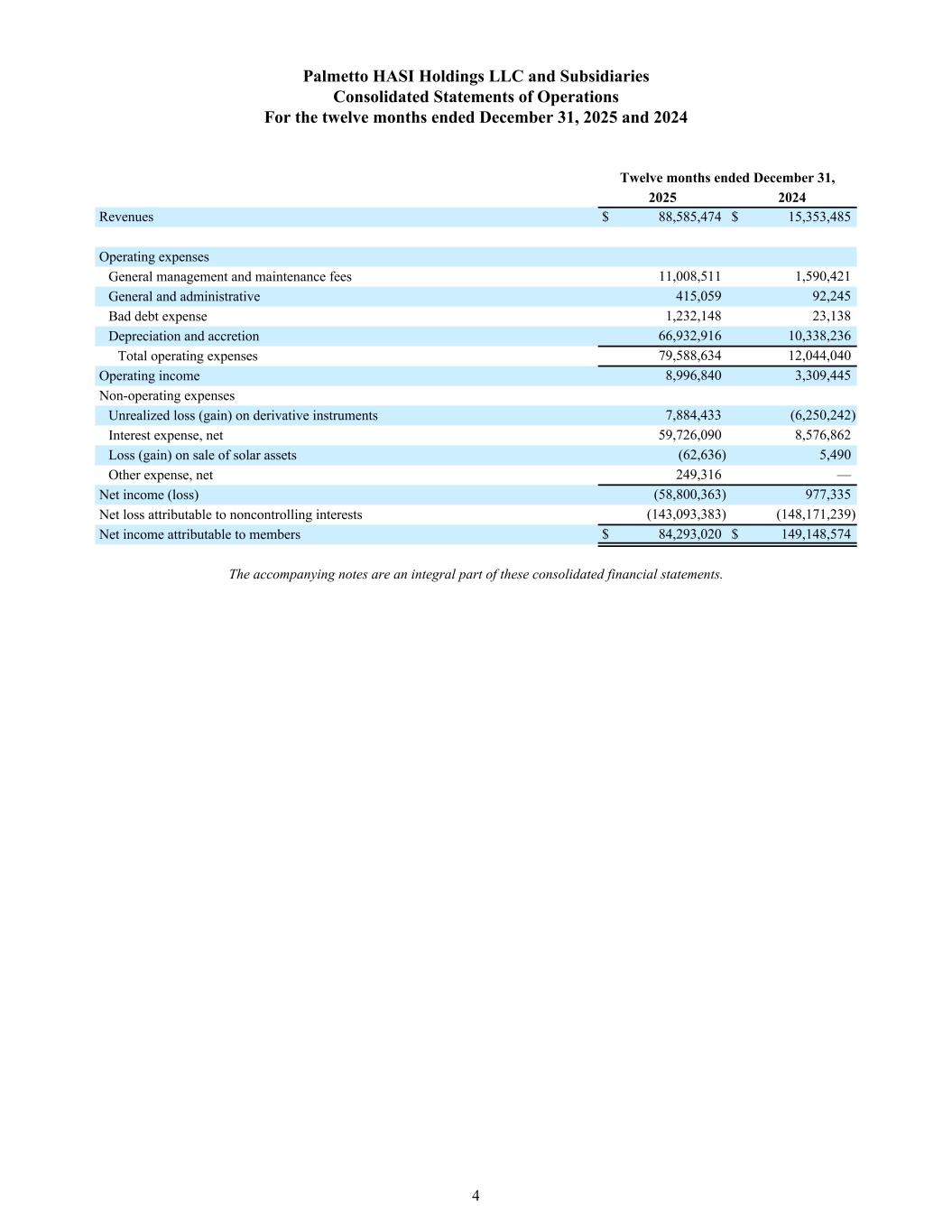
Palmetto HASI Holdings LLC and Subsidiaries Consolidated Statements of Operations For the twelve months ended December 31, 2025 and 2024 Twelve months ended December 31, 2025 2024 Revenues $ 88,585,474 $ 15,353,485 Operating expenses General management and maintenance fees 11,008,511 1,590,421 General and administrative 415,059 92,245 Bad debt expense 1,232,148 23,138 Depreciation and accretion 66,932,916 10,338,236 Total operating expenses 79,588,634 12,044,040 Operating income 8,996,840 3,309,445 Non-operating expenses Unrealized loss (gain) on derivative instruments 7,884,433 (6,250,242) Interest expense, net 59,726,090 8,576,862 Loss (gain) on sale of solar assets (62,636) 5,490 Other expense, net 249,316 — Net income (loss) (58,800,363) 977,335 Net loss attributable to noncontrolling interests (143,093,383) (148,171,239) Net income attributable to members $ 84,293,020 $ 149,148,574 The accompanying notes are an integral part of these consolidated financial statements. 4
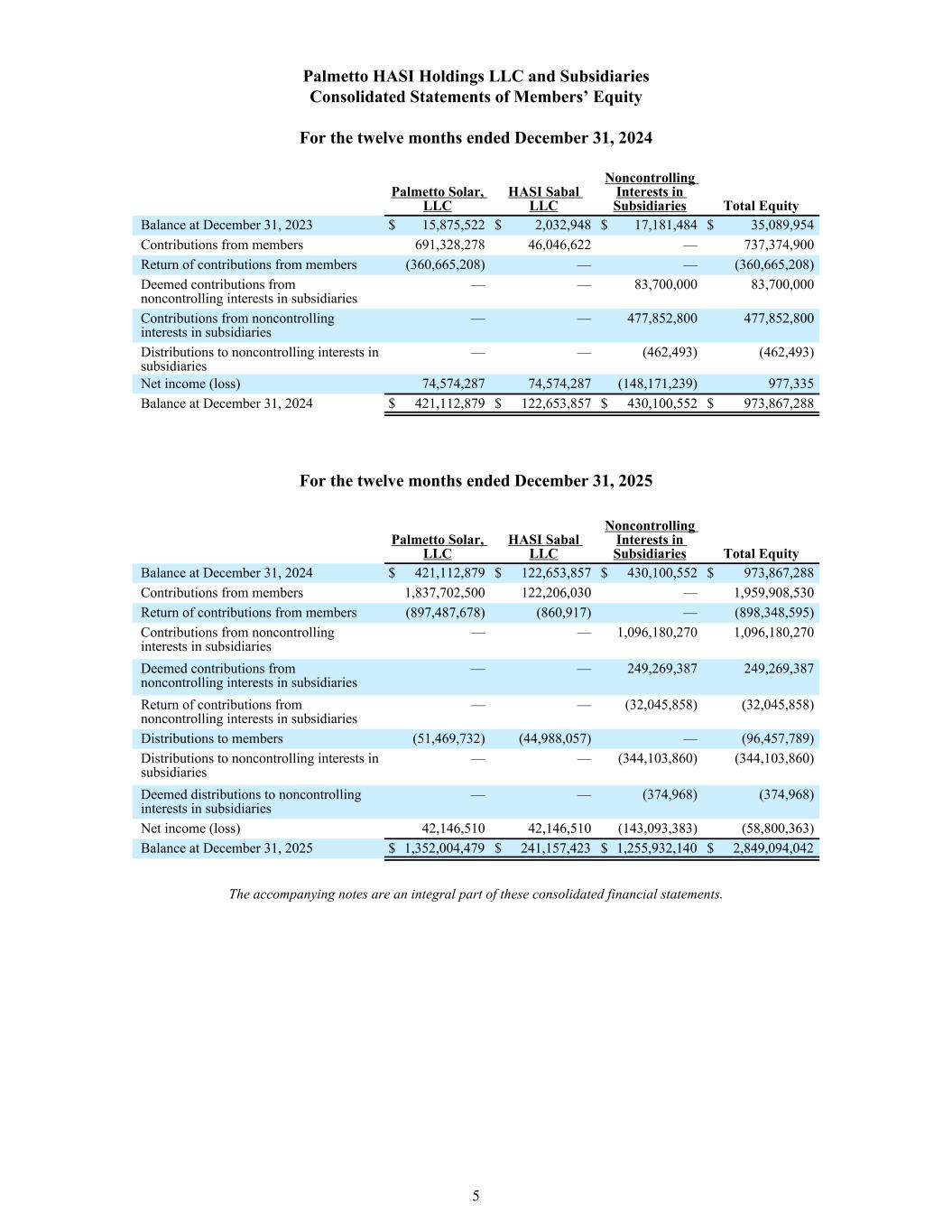
Palmetto HASI Holdings LLC and Subsidiaries Consolidated Statements of Members’ Equity For the twelve months ended December 31, 2024 Palmetto Solar, LLC HASI Sabal LLC Noncontrolling Interests in Subsidiaries Total Equity Balance at December 31, 2023 $ 15,875,522 $ 2,032,948 $ 17,181,484 $ 35,089,954 Contributions from members 691,328,278 46,046,622 — 737,374,900 Return of contributions from members (360,665,208) — — (360,665,208) Deemed contributions from noncontrolling interests in subsidiaries — — 83,700,000 83,700,000 Contributions from noncontrolling interests in subsidiaries — — 477,852,800 477,852,800 Distributions to noncontrolling interests in subsidiaries — — (462,493) (462,493) Net income (loss) 74,574,287 74,574,287 (148,171,239) 977,335 Balance at December 31, 2024 $ 421,112,879 $ 122,653,857 $ 430,100,552 $ 973,867,288 For the twelve months ended December 31, 2025 Palmetto Solar, LLC HASI Sabal LLC Noncontrolling Interests in Subsidiaries Total Equity Balance at December 31, 2024 $ 421,112,879 $ 122,653,857 $ 430,100,552 $ 973,867,288 Contributions from members 1,837,702,500 122,206,030 — 1,959,908,530 Return of contributions from members (897,487,678) (860,917) — (898,348,595) Contributions from noncontrolling interests in subsidiaries — — 1,096,180,270 1,096,180,270 Deemed contributions from noncontrolling interests in subsidiaries — — 249,269,387 249,269,387 Return of contributions from noncontrolling interests in subsidiaries — — (32,045,858) (32,045,858) Distributions to members (51,469,732) (44,988,057) — (96,457,789) Distributions to noncontrolling interests in subsidiaries — — (344,103,860) (344,103,860) Deemed distributions to noncontrolling interests in subsidiaries — — (374,968) (374,968) Net income (loss) 42,146,510 42,146,510 (143,093,383) (58,800,363) Balance at December 31, 2025 $ 1,352,004,479 $ 241,157,423 $ 1,255,932,140 $ 2,849,094,042 The accompanying notes are an integral part of these consolidated financial statements. 5
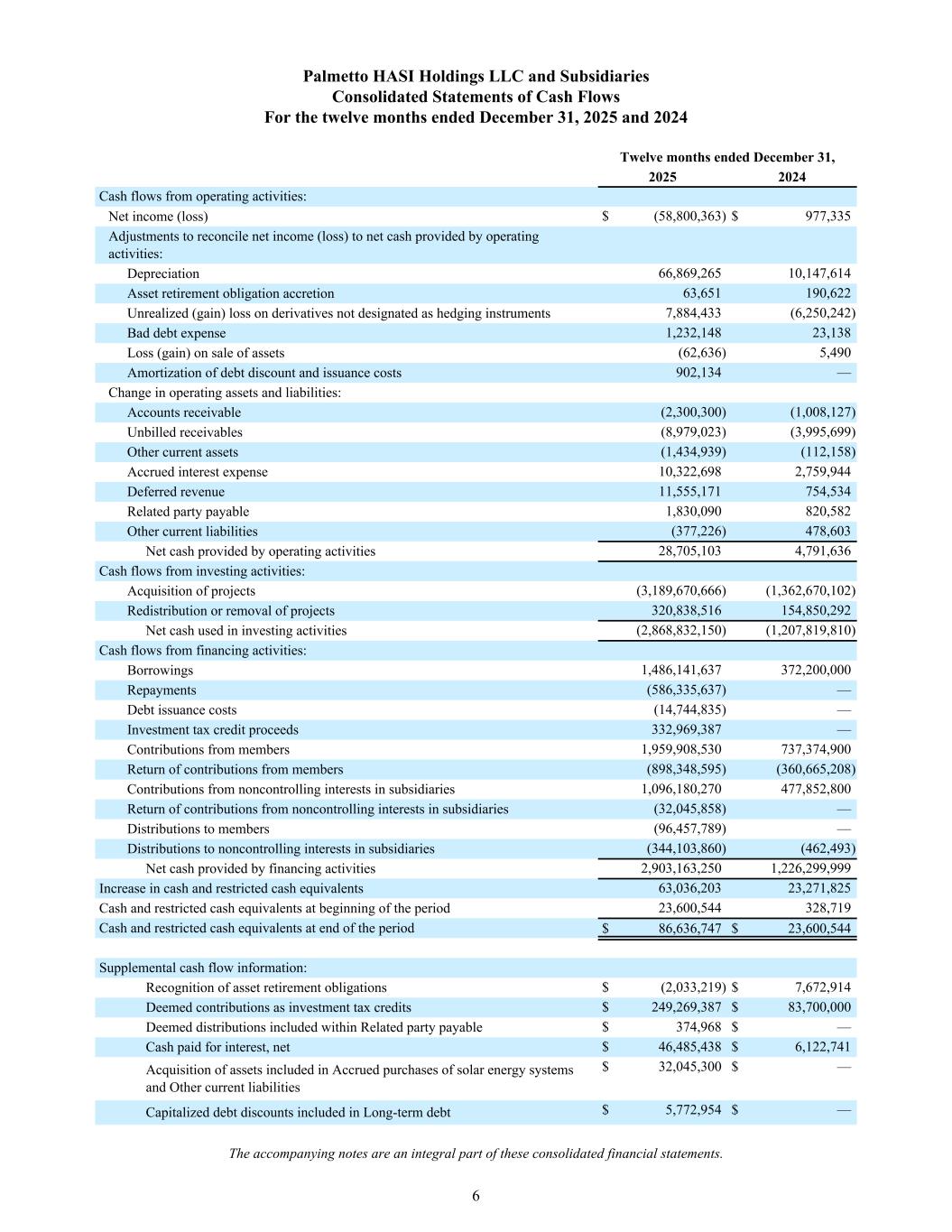
Palmetto HASI Holdings LLC and Subsidiaries Consolidated Statements of Cash Flows For the twelve months ended December 31, 2025 and 2024 Twelve months ended December 31, 2025 2024 Cash flows from operating activities: Net income (loss) $ (58,800,363) $ 977,335 Adjustments to reconcile net income (loss) to net cash provided by operating activities: Depreciation 66,869,265 10,147,614 Asset retirement obligation accretion 63,651 190,622 Unrealized (gain) loss on derivatives not designated as hedging instruments 7,884,433 (6,250,242) Bad debt expense 1,232,148 23,138 Loss (gain) on sale of assets (62,636) 5,490 Amortization of debt discount and issuance costs 902,134 — Change in operating assets and liabilities: Accounts receivable (2,300,300) (1,008,127) Unbilled receivables (8,979,023) (3,995,699) Other current assets (1,434,939) (112,158) Accrued interest expense 10,322,698 2,759,944 Deferred revenue 11,555,171 754,534 Related party payable 1,830,090 820,582 Other current liabilities (377,226) 478,603 Net cash provided by operating activities 28,705,103 4,791,636 Cash flows from investing activities: Acquisition of projects (3,189,670,666) (1,362,670,102) Redistribution or removal of projects 320,838,516 154,850,292 Net cash used in investing activities (2,868,832,150) (1,207,819,810) Cash flows from financing activities: Borrowings 1,486,141,637 372,200,000 Repayments (586,335,637) — Debt issuance costs (14,744,835) — Investment tax credit proceeds 332,969,387 — Contributions from members 1,959,908,530 737,374,900 Return of contributions from members (898,348,595) (360,665,208) Contributions from noncontrolling interests in subsidiaries 1,096,180,270 477,852,800 Return of contributions from noncontrolling interests in subsidiaries (32,045,858) — Distributions to members (96,457,789) — Distributions to noncontrolling interests in subsidiaries (344,103,860) (462,493) Net cash provided by financing activities 2,903,163,250 1,226,299,999 Increase in cash and restricted cash equivalents 63,036,203 23,271,825 Cash and restricted cash equivalents at beginning of the period 23,600,544 328,719 Cash and restricted cash equivalents at end of the period $ 86,636,747 $ 23,600,544 Supplemental cash flow information: Recognition of asset retirement obligations $ (2,033,219) $ 7,672,914 Deemed contributions as investment tax credits $ 249,269,387 $ 83,700,000 Deemed distributions included within Related party payable $ 374,968 $ — Cash paid for interest, net $ 46,485,438 $ 6,122,741 Acquisition of assets included in Accrued purchases of solar energy systems and Other current liabilities $ 32,045,300 $ — Capitalized debt discounts included in Long-term debt $ 5,772,954 $ — The accompanying notes are an integral part of these consolidated financial statements. 6
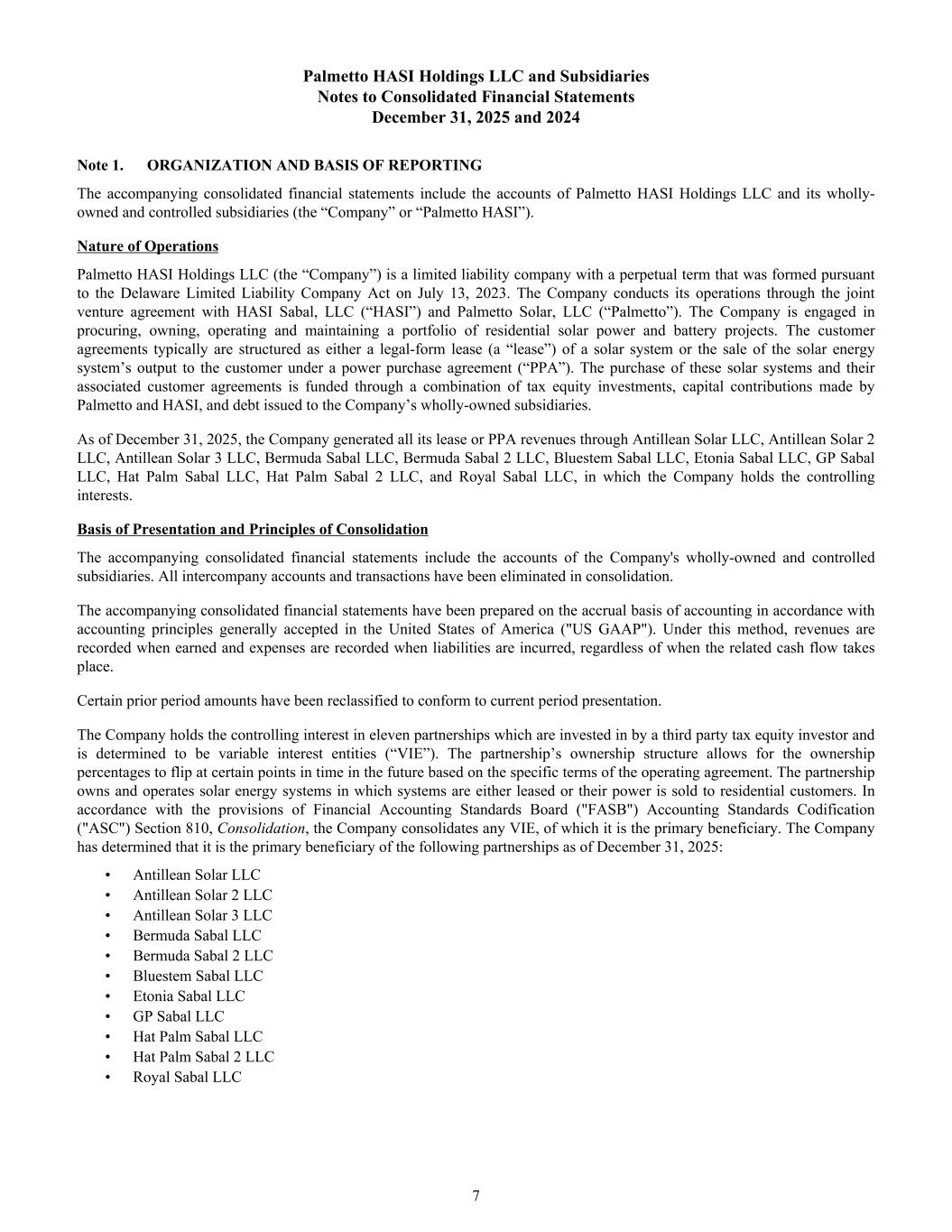
Palmetto HASI Holdings LLC and Subsidiaries Notes to Consolidated Financial Statements December 31, 2025 and 2024 Note 1. ORGANIZATION AND BASIS OF REPORTING The accompanying consolidated financial statements include the accounts of Palmetto HASI Holdings LLC and its wholly- owned and controlled subsidiaries (the “Company” or “Palmetto HASI”). Nature of Operations Palmetto HASI Holdings LLC (the “Company”) is a limited liability company with a perpetual term that was formed pursuant to the Delaware Limited Liability Company Act on July 13, 2023. The Company conducts its operations through the joint venture agreement with HASI Sabal, LLC (“HASI”) and Palmetto Solar, LLC (“Palmetto”). The Company is engaged in procuring, owning, operating and maintaining a portfolio of residential solar power and battery projects. The customer agreements typically are structured as either a legal-form lease (a “lease”) of a solar system or the sale of the solar energy system’s output to the customer under a power purchase agreement (“PPA”). The purchase of these solar systems and their associated customer agreements is funded through a combination of tax equity investments, capital contributions made by Palmetto and HASI, and debt issued to the Company’s wholly-owned subsidiaries. As of December 31, 2025, the Company generated all its lease or PPA revenues through Antillean Solar LLC, Antillean Solar 2 LLC, Antillean Solar 3 LLC, Bermuda Sabal LLC, Bermuda Sabal 2 LLC, Bluestem Sabal LLC, Etonia Sabal LLC, GP Sabal LLC, Hat Palm Sabal LLC, Hat Palm Sabal 2 LLC, and Royal Sabal LLC, in which the Company holds the controlling interests. Basis of Presentation and Principles of Consolidation The accompanying consolidated financial statements include the accounts of the Company's wholly-owned and controlled subsidiaries. All intercompany accounts and transactions have been eliminated in consolidation. The accompanying consolidated financial statements have been prepared on the accrual basis of accounting in accordance with accounting principles generally accepted in the United States of America ("US GAAP"). Under this method, revenues are recorded when earned and expenses are recorded when liabilities are incurred, regardless of when the related cash flow takes place. Certain prior period amounts have been reclassified to conform to current period presentation. The Company holds the controlling interest in eleven partnerships which are invested in by a third party tax equity investor and is determined to be variable interest entities (“VIE”). The partnership’s ownership structure allows for the ownership percentages to flip at certain points in time in the future based on the specific terms of the operating agreement. The partnership owns and operates solar energy systems in which systems are either leased or their power is sold to residential customers. In accordance with the provisions of Financial Accounting Standards Board ("FASB") Accounting Standards Codification ("ASC") Section 810, Consolidation, the Company consolidates any VIE, of which it is the primary beneficiary. The Company has determined that it is the primary beneficiary of the following partnerships as of December 31, 2025: • Antillean Solar LLC • Antillean Solar 2 LLC • Antillean Solar 3 LLC • Bermuda Sabal LLC • Bermuda Sabal 2 LLC • Bluestem Sabal LLC • Etonia Sabal LLC • GP Sabal LLC • Hat Palm Sabal LLC • Hat Palm Sabal 2 LLC • Royal Sabal LLC 7
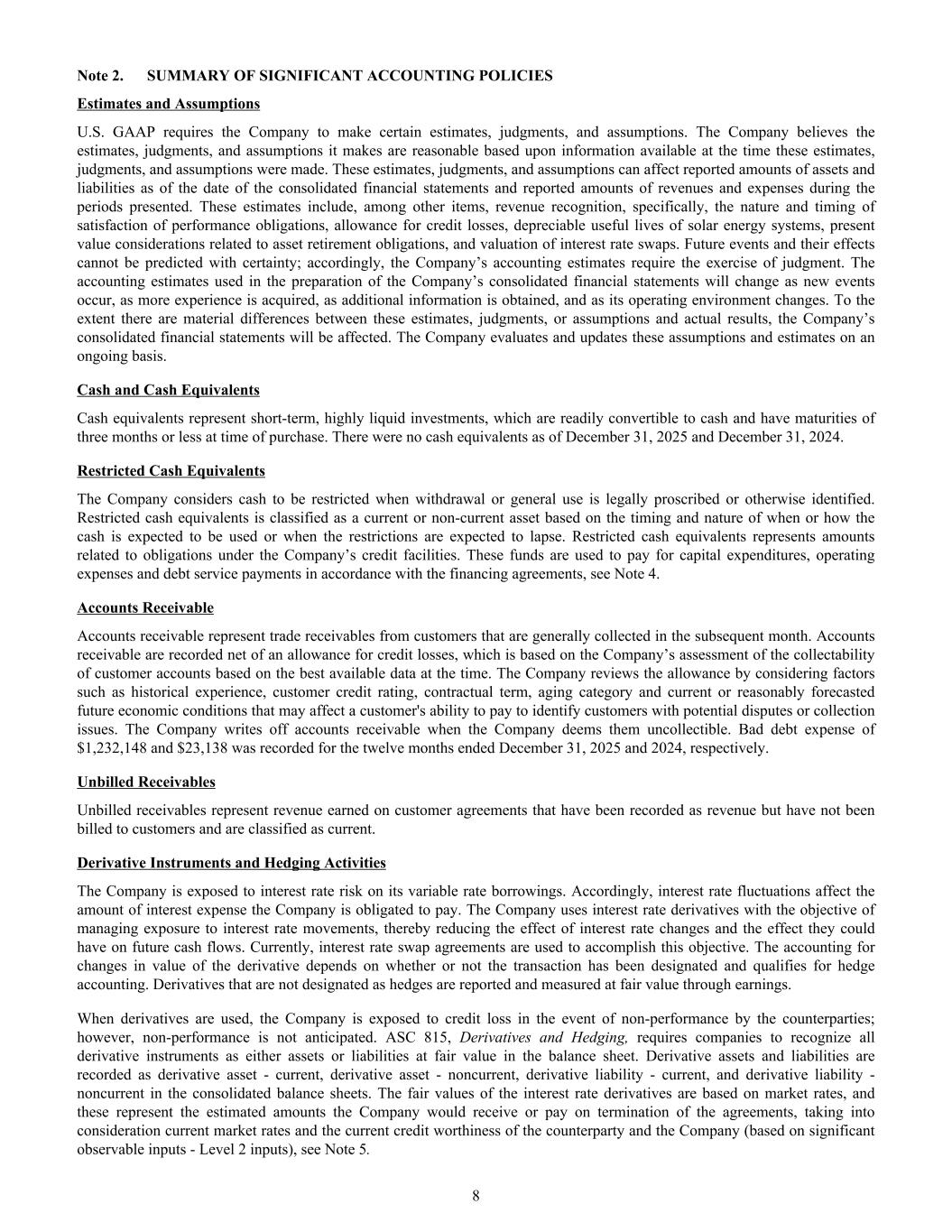
Note 2. SUMMARY OF SIGNIFICANT ACCOUNTING POLICIES Estimates and Assumptions U.S. GAAP requires the Company to make certain estimates, judgments, and assumptions. The Company believes the estimates, judgments, and assumptions it makes are reasonable based upon information available at the time these estimates, judgments, and assumptions were made. These estimates, judgments, and assumptions can affect reported amounts of assets and liabilities as of the date of the consolidated financial statements and reported amounts of revenues and expenses during the periods presented. These estimates include, among other items, revenue recognition, specifically, the nature and timing of satisfaction of performance obligations, allowance for credit losses, depreciable useful lives of solar energy systems, present value considerations related to asset retirement obligations, and valuation of interest rate swaps. Future events and their effects cannot be predicted with certainty; accordingly, the Company’s accounting estimates require the exercise of judgment. The accounting estimates used in the preparation of the Company’s consolidated financial statements will change as new events occur, as more experience is acquired, as additional information is obtained, and as its operating environment changes. To the extent there are material differences between these estimates, judgments, or assumptions and actual results, the Company’s consolidated financial statements will be affected. The Company evaluates and updates these assumptions and estimates on an ongoing basis. Cash and Cash Equivalents Cash equivalents represent short-term, highly liquid investments, which are readily convertible to cash and have maturities of three months or less at time of purchase. There were no cash equivalents as of December 31, 2025 and December 31, 2024. Restricted Cash Equivalents The Company considers cash to be restricted when withdrawal or general use is legally proscribed or otherwise identified. Restricted cash equivalents is classified as a current or non-current asset based on the timing and nature of when or how the cash is expected to be used or when the restrictions are expected to lapse. Restricted cash equivalents represents amounts related to obligations under the Company’s credit facilities. These funds are used to pay for capital expenditures, operating expenses and debt service payments in accordance with the financing agreements, see Note 4. Accounts Receivable Accounts receivable represent trade receivables from customers that are generally collected in the subsequent month. Accounts receivable are recorded net of an allowance for credit losses, which is based on the Company’s assessment of the collectability of customer accounts based on the best available data at the time. The Company reviews the allowance by considering factors such as historical experience, customer credit rating, contractual term, aging category and current or reasonably forecasted future economic conditions that may affect a customer's ability to pay to identify customers with potential disputes or collection issues. The Company writes off accounts receivable when the Company deems them uncollectible. Bad debt expense of $1,232,148 and $23,138 was recorded for the twelve months ended December 31, 2025 and 2024, respectively. Unbilled Receivables Unbilled receivables represent revenue earned on customer agreements that have been recorded as revenue but have not been billed to customers and are classified as current. Derivative Instruments and Hedging Activities The Company is exposed to interest rate risk on its variable rate borrowings. Accordingly, interest rate fluctuations affect the amount of interest expense the Company is obligated to pay. The Company uses interest rate derivatives with the objective of managing exposure to interest rate movements, thereby reducing the effect of interest rate changes and the effect they could have on future cash flows. Currently, interest rate swap agreements are used to accomplish this objective. The accounting for changes in value of the derivative depends on whether or not the transaction has been designated and qualifies for hedge accounting. Derivatives that are not designated as hedges are reported and measured at fair value through earnings. When derivatives are used, the Company is exposed to credit loss in the event of non-performance by the counterparties; however, non-performance is not anticipated. ASC 815, Derivatives and Hedging, requires companies to recognize all derivative instruments as either assets or liabilities at fair value in the balance sheet. Derivative assets and liabilities are recorded as derivative asset - current, derivative asset - noncurrent, derivative liability - current, and derivative liability - noncurrent in the consolidated balance sheets. The fair values of the interest rate derivatives are based on market rates, and these represent the estimated amounts the Company would receive or pay on termination of the agreements, taking into consideration current market rates and the current credit worthiness of the counterparty and the Company (based on significant observable inputs - Level 2 inputs), see Note 5. 8
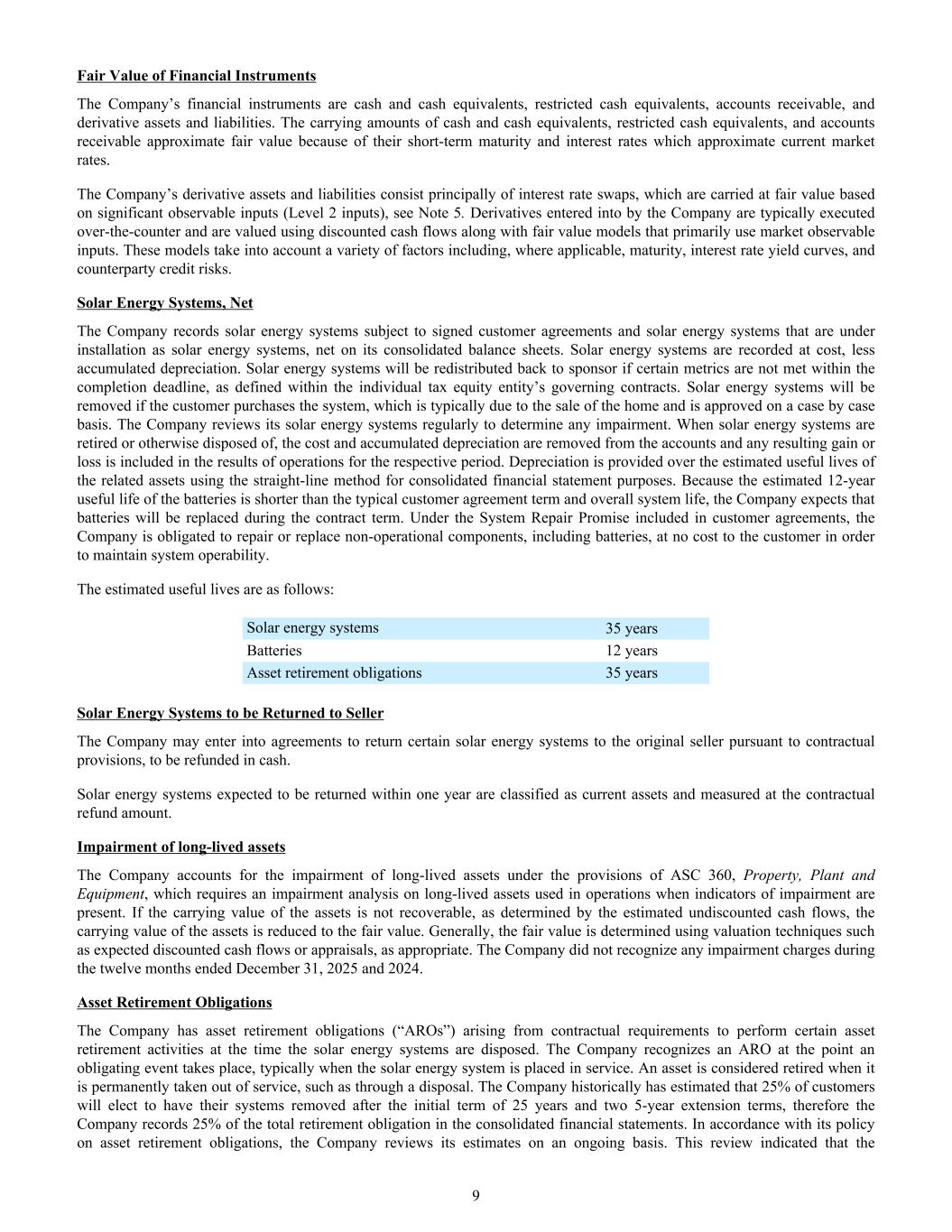
Fair Value of Financial Instruments The Company’s financial instruments are cash and cash equivalents, restricted cash equivalents, accounts receivable, and derivative assets and liabilities. The carrying amounts of cash and cash equivalents, restricted cash equivalents, and accounts receivable approximate fair value because of their short-term maturity and interest rates which approximate current market rates. The Company’s derivative assets and liabilities consist principally of interest rate swaps, which are carried at fair value based on significant observable inputs (Level 2 inputs), see Note 5. Derivatives entered into by the Company are typically executed over-the-counter and are valued using discounted cash flows along with fair value models that primarily use market observable inputs. These models take into account a variety of factors including, where applicable, maturity, interest rate yield curves, and counterparty credit risks. Solar Energy Systems, Net The Company records solar energy systems subject to signed customer agreements and solar energy systems that are under installation as solar energy systems, net on its consolidated balance sheets. Solar energy systems are recorded at cost, less accumulated depreciation. Solar energy systems will be redistributed back to sponsor if certain metrics are not met within the completion deadline, as defined within the individual tax equity entity’s governing contracts. Solar energy systems will be removed if the customer purchases the system, which is typically due to the sale of the home and is approved on a case by case basis. The Company reviews its solar energy systems regularly to determine any impairment. When solar energy systems are retired or otherwise disposed of, the cost and accumulated depreciation are removed from the accounts and any resulting gain or loss is included in the results of operations for the respective period. Depreciation is provided over the estimated useful lives of the related assets using the straight-line method for consolidated financial statement purposes. Because the estimated 12-year useful life of the batteries is shorter than the typical customer agreement term and overall system life, the Company expects that batteries will be replaced during the contract term. Under the System Repair Promise included in customer agreements, the Company is obligated to repair or replace non-operational components, including batteries, at no cost to the customer in order to maintain system operability. The estimated useful lives are as follows: Solar energy systems 35 years Batteries 12 years Asset retirement obligations 35 years Solar Energy Systems to be Returned to Seller The Company may enter into agreements to return certain solar energy systems to the original seller pursuant to contractual provisions, to be refunded in cash. Solar energy systems expected to be returned within one year are classified as current assets and measured at the contractual refund amount. Impairment of long-lived assets The Company accounts for the impairment of long-lived assets under the provisions of ASC 360, Property, Plant and Equipment, which requires an impairment analysis on long-lived assets used in operations when indicators of impairment are present. If the carrying value of the assets is not recoverable, as determined by the estimated undiscounted cash flows, the carrying value of the assets is reduced to the fair value. Generally, the fair value is determined using valuation techniques such as expected discounted cash flows or appraisals, as appropriate. The Company did not recognize any impairment charges during the twelve months ended December 31, 2025 and 2024. Asset Retirement Obligations The Company has asset retirement obligations (“AROs”) arising from contractual requirements to perform certain asset retirement activities at the time the solar energy systems are disposed. The Company recognizes an ARO at the point an obligating event takes place, typically when the solar energy system is placed in service. An asset is considered retired when it is permanently taken out of service, such as through a disposal. The Company historically has estimated that 25% of customers will elect to have their systems removed after the initial term of 25 years and two 5-year extension terms, therefore the Company records 25% of the total retirement obligation in the consolidated financial statements. In accordance with its policy on asset retirement obligations, the Company reviews its estimates on an ongoing basis. This review indicated that the 9
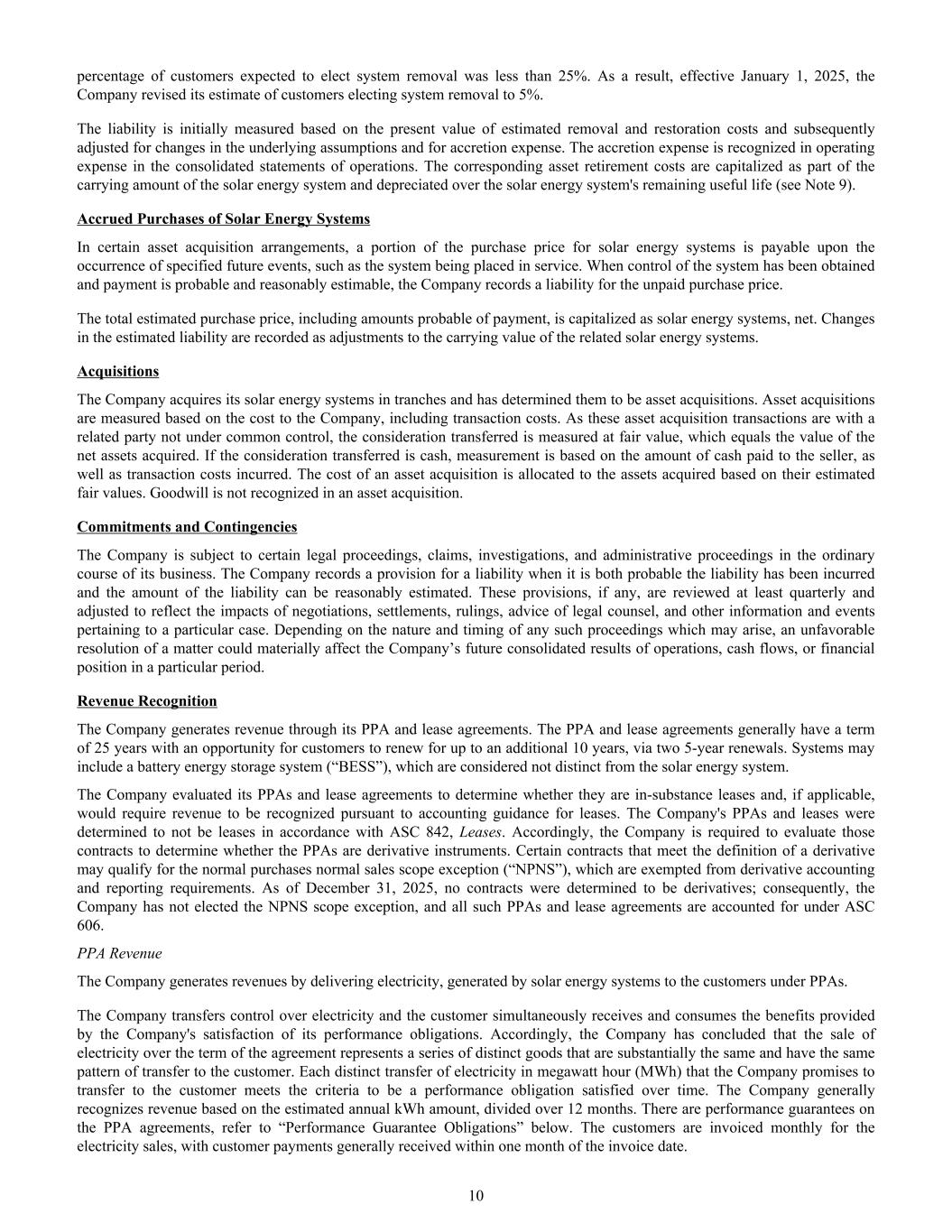
percentage of customers expected to elect system removal was less than 25%. As a result, effective January 1, 2025, the Company revised its estimate of customers electing system removal to 5%. The liability is initially measured based on the present value of estimated removal and restoration costs and subsequently adjusted for changes in the underlying assumptions and for accretion expense. The accretion expense is recognized in operating expense in the consolidated statements of operations. The corresponding asset retirement costs are capitalized as part of the carrying amount of the solar energy system and depreciated over the solar energy system's remaining useful life (see Note 9). Accrued Purchases of Solar Energy Systems In certain asset acquisition arrangements, a portion of the purchase price for solar energy systems is payable upon the occurrence of specified future events, such as the system being placed in service. When control of the system has been obtained and payment is probable and reasonably estimable, the Company records a liability for the unpaid purchase price. The total estimated purchase price, including amounts probable of payment, is capitalized as solar energy systems, net. Changes in the estimated liability are recorded as adjustments to the carrying value of the related solar energy systems. Acquisitions The Company acquires its solar energy systems in tranches and has determined them to be asset acquisitions. Asset acquisitions are measured based on the cost to the Company, including transaction costs. As these asset acquisition transactions are with a related party not under common control, the consideration transferred is measured at fair value, which equals the value of the net assets acquired. If the consideration transferred is cash, measurement is based on the amount of cash paid to the seller, as well as transaction costs incurred. The cost of an asset acquisition is allocated to the assets acquired based on their estimated fair values. Goodwill is not recognized in an asset acquisition. Commitments and Contingencies The Company is subject to certain legal proceedings, claims, investigations, and administrative proceedings in the ordinary course of its business. The Company records a provision for a liability when it is both probable the liability has been incurred and the amount of the liability can be reasonably estimated. These provisions, if any, are reviewed at least quarterly and adjusted to reflect the impacts of negotiations, settlements, rulings, advice of legal counsel, and other information and events pertaining to a particular case. Depending on the nature and timing of any such proceedings which may arise, an unfavorable resolution of a matter could materially affect the Company’s future consolidated results of operations, cash flows, or financial position in a particular period. Revenue Recognition The Company generates revenue through its PPA and lease agreements. The PPA and lease agreements generally have a term of 25 years with an opportunity for customers to renew for up to an additional 10 years, via two 5-year renewals. Systems may include a battery energy storage system (“BESS”), which are considered not distinct from the solar energy system. The Company evaluated its PPAs and lease agreements to determine whether they are in-substance leases and, if applicable, would require revenue to be recognized pursuant to accounting guidance for leases. The Company's PPAs and leases were determined to not be leases in accordance with ASC 842, Leases. Accordingly, the Company is required to evaluate those contracts to determine whether the PPAs are derivative instruments. Certain contracts that meet the definition of a derivative may qualify for the normal purchases normal sales scope exception (“NPNS”), which are exempted from derivative accounting and reporting requirements. As of December 31, 2025, no contracts were determined to be derivatives; consequently, the Company has not elected the NPNS scope exception, and all such PPAs and lease agreements are accounted for under ASC 606. PPA Revenue The Company generates revenues by delivering electricity, generated by solar energy systems to the customers under PPAs. The Company transfers control over electricity and the customer simultaneously receives and consumes the benefits provided by the Company's satisfaction of its performance obligations. Accordingly, the Company has concluded that the sale of electricity over the term of the agreement represents a series of distinct goods that are substantially the same and have the same pattern of transfer to the customer. Each distinct transfer of electricity in megawatt hour (MWh) that the Company promises to transfer to the customer meets the criteria to be a performance obligation satisfied over time. The Company generally recognizes revenue based on the estimated annual kWh amount, divided over 12 months. There are performance guarantees on the PPA agreements, refer to “Performance Guarantee Obligations” below. The customers are invoiced monthly for the electricity sales, with customer payments generally received within one month of the invoice date. 10
Lease Revenue The Company is the lessor under lease agreements for solar energy systems, which do not meet the definition of a lease under ASC 842 and are accounted for as contracts with customers under ASC 606. The Company recognizes revenue based on the monthly lease payment per the customer agreement. The Company is the lessor under lease agreements for solar energy systems. There are performance guarantees on the lease agreements, refer to “Performance Guarantee Obligations” below. The customers are invoiced monthly for the electricity sales, with customer payments generally received within one month of the invoice date. Solar Renewable Energy Certificate (“SREC”) Revenue Each megawatt hour of electricity produced by the solar energy systems generates one solar renewable energy certificate ("SREC"). The Company accounts for its internally generated SRECs under the incremental cost method and has determined the costs associated with the SRECs to be nominal and thus has recorded no value. A portion of the SRECs generated are sold to third parties in certain jurisdictions for an upfront, lump sum payment based on the installed kilowatt (kW) capacity of each solar energy system for a term of 25 years. The Company’s performance obligation is to deliver all SRECs generated by the system, with no minimum or maximum deliver quantities. The Company recognizes SREC revenue on a straight-line basis over the contract term as the Company satisfies its obligation to provide the rights to the SRECs and to provide continuous monitoring access to the solar energy system. Uncontracted SRECs are held in SREC inventory until monetization. Deferred Revenue When the Company receives consideration, or when such consideration is unconditionally due, from a customer prior to delivering services to the customer under the terms of a PPA, lease or SREC agreement for a customer, the Company records deferred revenue. Such deferred revenue consists of amounts for which the criteria for revenue recognition have not yet been met and includes amounts that are collected or assigned from customers, including upfront deposits and prepayments, and rebates. Performance Guarantee Obligations In most cases, the Company guarantees certain specified minimum solar energy production output under the lease and PPA agreements, generally over a term of 25 years. The amounts are generally measured and credited to the customer's account thirty-six months after the solar energy system’s placed in service date, and every thirty-six months thereafter. The Company monitors the solar energy systems to ensure these outputs are achieved. The Company evaluates if any amounts are due to the customers based upon not meeting the guaranteed solar energy production outputs at each reporting period end. For leases and PPAs, these estimated amounts are recorded as a reduction to revenues from customers and a current or long-term liability, as applicable. As of December 31, 2025 and December 31, 2024, no amounts were due to the customers under the performance guarantee obligation. Income Taxes The Company is treated as a disregarded entity for income tax purposes and as such, is not subject to income taxes. Rather, all items of taxable income and deductions are disregarded and passed through to and are reported by its member in their income tax return. The Company's federal tax status as a disregarded entity is based on its legal status as a limited liability company with two members. Accordingly, the Company is not required to take any tax positions to qualify as a disregarded entity. These consolidated financial statements do not reflect a provision for income taxes and the Company has no other tax positions which must be considered for disclosure. One subsidiary of the Company is taxed as a Corporation, however, there was no material impact to the consolidated financial statements for the twelve months ended December 31, 2025 and 2024. The Company elected to account for transferrable ITCs under ASC 740, Income Taxes, using the flow-through method when it is entitled to consideration under the terms of transfer arrangements. As of December 31, 2025, the Company was not entitled to any consideration under transfer agreements. As of December 31, 2024, a receivable of $83,700,000, which is reflected in other current assets on the consolidated balance sheets, and an offsetting capital contribution from Morgan Stanley Renewables Inc. were recorded. As of December 31, 2025, this receivable has been received. Debt Issuance Costs The Company capitalizes debt discount and deferred financing costs incurred related to debt issuance. Debt issuance costs are presented in the consolidated balance sheets as a direct deduction from the carrying amount of the related debt liability, and amortized using the effective interest method. The amortization of debt issuance costs is classified as interest expense on the consolidated statements of operations. Concentrations of credit risk 11
Financial instruments that potentially subject the Company to concentrations of credit risk consist principally of cash deposits and derivative instruments. Cash deposits are guaranteed by the Federal Deposit Insurance Corporation ("FDIC") up to federally insured limits. The Company may at times have deposits in excess of FDIC insured limits. The Company has not experienced any losses in such accounts. The Company has no policy requiring collateral or other securities to support its deposits. Variable interest entities ("VIE") The Company determines when it should include the assets, liabilities, and activities of a VIE in its consolidated financial statements and when it should disclose information about its relationship with a VIE when it is determined to be the primary beneficiary of the VIE. A VIE must be consolidated by a company if it is the primary beneficiary of the entity. The primary beneficiary of a VIE is the entity that has (1) the power to direct the activities of the VIE that most significantly impact the VIE's economic performance and (2) the obligation to absorb losses or receive benefits that could potentially be significant to the VIE. If multiple unrelated parties share such power, as defined, no party is required to consolidate the VIE. The Company determines whether an entity is a VIE and whether it is the primary beneficiary at the date of initial involvement with the entity. The Company reassesses whether it is the primary beneficiary of a VIE on an ongoing basis based on changes in facts and circumstances. In determining whether it is the primary beneficiary, the Company considers the purpose and activities of the VIE, including the variability and related risks the VIE incurs and transfers to other entities and their related parties. These factors are considered in determining whether the Company has the power to direct activities of the VIE that most significantly impact the VIE's economic performance and whether the Company also has the obligation to absorb losses of or receive benefits from the VIE that could be potentially significant to the VIE. If the Company determines that it is the primary beneficiary of the VIE, the VIE is consolidated within the Company's consolidated financial statements. Noncontrolling Interests in Subsidiaries Noncontrolling interests represent third-party interests in the net assets of certain consolidated subsidiaries (the "tax equity entities"). For these tax equity entities, the Company has determined the appropriate methodology for calculating the noncontrolling interest balances that reflects the substantive economic arrangements in the operating agreements is a balance sheet approach using the hypothetical liquidation at book value ("HLBV") method. Under the HLBV method, the amounts reported as noncontrolling interests in the consolidated balance sheets represent the amounts third-party investors would hypothetically receive at each balance sheet date under the liquidation provisions of the operating agreements, assuming the net assets of the subsidiaries were liquidated at amounts determined in accordance with GAAP and distributed to the investors. The noncontrolling interest balances in these subsidiaries are reported as a component of equity in the consolidated balance sheets. The amount of income or loss allocated to noncontrolling interests in the results of operations for the subsidiaries using HLBV are determined as the difference in the noncontrolling interest balances in the consolidated balance sheets at the start and end of each reporting period, after taking into account any capital transactions between the subsidiaries and the third-party investors. Factors used in the HLBV calculation include GAAP income (loss), taxable income (loss), capital contributions, investment tax credits, distributions and the stipulated targeted investor return specified in the subsidiaries' operating agreements. Changes in these factors could have a significant impact on the amounts that investors would receive upon a hypothetical liquidation. The use of the HLBV method to allocate income (loss) to the noncontrolling interest holders may create volatility in the consolidated statements of operations as the application of HLBV can drive changes in net income or loss attributable to noncontrolling interests from period to period. Risks and Uncertainties The Company is subject to risks and uncertainties common to companies in the renewable energy industry, including, but not limited to: (i) credit risk related to its commercial and residential customers; (ii) reliance on the continued performance and reliability of its systems, infrastructure, and third-party service providers; (iii) changes in federal, state, and local laws and regulations; (iv) weather conditions and other environmental factors that may impact energy production; (v) financial market conditions and access to capital; and (vi) the successful operation and performance of power markets. Recently Adopted and Issued Accounting Pronouncements In December 2025, the Financial Accounting Standards Board FASB issued ASU No. 2025-10, Government Grants (Topic 832): Accounting for Government Grants Received by Business Entities (“ASU 2025-10”) to establish authoritative guidance on how to recognize, measure, and present government grants received by business entities. The amendments in this pronouncement establish the accounting for a government grant received by a business entity, including guidance for (1) a grant related to an asset and (2) a grant related to income. A grant related to an asset is a government grant, or part of a government grant, that is conditioned on the purchase, construction, or acquisition of an asset. A grant related to income is a government grant, or part of a government grant, other than a grant related to an asset. ASU 2025-10 is effective for annual periods 12
beginning after December 15, 2028, and for interim reporting periods within those annual reporting periods. The ASU may be applied using a modified prospective, modified retrospective or retrospective approach with early adoption permitted in an interim or annual reporting period. If an entity early adopts in an interim reporting period, it must adopt as of the beginning of the annual reporting period that includes that interim reporting period. The Company is evaluating the impact this will have on its consolidated financial statements and does not currently expect there to be an impact of the recognition of our transferable ITCs under ASC 740. Note 3. REVENUE RECOGNITION Revenues consist of the following: Twelve months ended December 31, 2025 2024 PPA revenue $ 50,635,279 $ 8,145,642 Lease revenue 37,770,315 7,189,602 SREC revenue 179,880 18,241 Total revenues $ 88,585,474 $ 15,353,485 The opening balance of deferred revenue was $252 as of December 31, 2023. Deferred revenue consists of the following: As of December 31, 2025 December 31, 2024 Payments received under customer agreements $ 3,516,975 $ 125,985 Payments received under SREC contracts, current 359,644 25,703 Deferred revenue - current 3,876,619 151,688 Payments received under SREC contracts, non-current 8,433,338 603,098 Total deferred revenue $ 12,309,957 $ 754,786 Note 4. RESTRICTED CASH EQUIVALENTS Restrictions on Cash As of December 31, 2025 and December 31, 2024, the Company identified as restricted cash equivalents amounts related to its Credit Facility, ABS-1 Facility and ABS-2 Facility (see Note 10). Restricted cash equivalents supports each of the following: As of December 31, 2025 December 31, 2024 Credit Facility $ 24,680,258 $ 15,277,145 ABS-1 Facility 9,063,317 — ABS-2 Facility 23,295,959 — Total restricted cash equivalents $ 57,039,534 $ 15,277,145 13
Reconciliation of Cash and Restricted Cash Equivalents The following table provides a reconciliation of cash and restricted cash equivalents reported on the consolidated balance sheets that sum to the total of the same such amounts shown in the consolidated statements of cash flows: As of December 31, 2025 December 31, 2024 Cash $ 29,597,213 $ 8,323,399 Restricted cash equivalents 57,039,534 $ 15,277,145 Total cash and restricted cash equivalents shown in the consolidated statements of cash flows $ 86,636,747 $ 23,600,544 Note 5. FAIR VALUE MEASUREMENTS Fair value is the price that would be received to sell an asset or paid to transfer a liability in an orderly transaction between market participants at the measurement date and the fair value measurement guidance in U.S. GAAP sets forth a fair value hierarchy. The fair value hierarchy gives the highest priority to quoted prices in active markets for identical assets or liabilities (Level 1) and the lowest priority to unobservable inputs (Level 3). Inputs are broadly defined as assumptions market participants would use in pricing an asset or liability. The three levels of the fair value hierarchy under Fair Value Measurement ASC Topic 820, Fair Value, are described below: Level 1: Unadjusted quoted prices in active markets for identical assets or liabilities that the reporting entity has the ability to access at the measurement date. Level 2: Inputs other than quoted prices within Level 1 that are observable for the asset or liability, either directly or indirectly, and fair value that is determined using models or other valuation methodologies. Level 3: Inputs that are unobservable for the asset or liability and that include situations where there is little, if any, market activity for the asset or liability. The inputs into the determination of fair value are based upon the best information in the circumstances and may require significant management judgment or estimation. The following table presents the fair value of the Company’s interest rate derivatives included in the consolidated balance sheets as of December 31, 2025: December 31, 2025 Level 1 Level 2 Level 3 Total Fair Value Financial assets: Derivatives Not Designated as Hedging Instruments $ — $ 1,395,466 $ — $ 1,395,466 Financial liabilities: Derivatives Not Designated as Hedging Instruments $ — $ 2,503,579 $ — $ 2,503,579 The following table presents the fair value of the Company’s interest rate derivatives included in the consolidated balance sheets as of December 31, 2024: December 31, 2024 Level 1 Level 2 Level 3 Total Fair Value Financial assets: Derivatives Not Designated as Hedging Instruments $ — $ 6,250,242 $ — $ 6,250,242 14
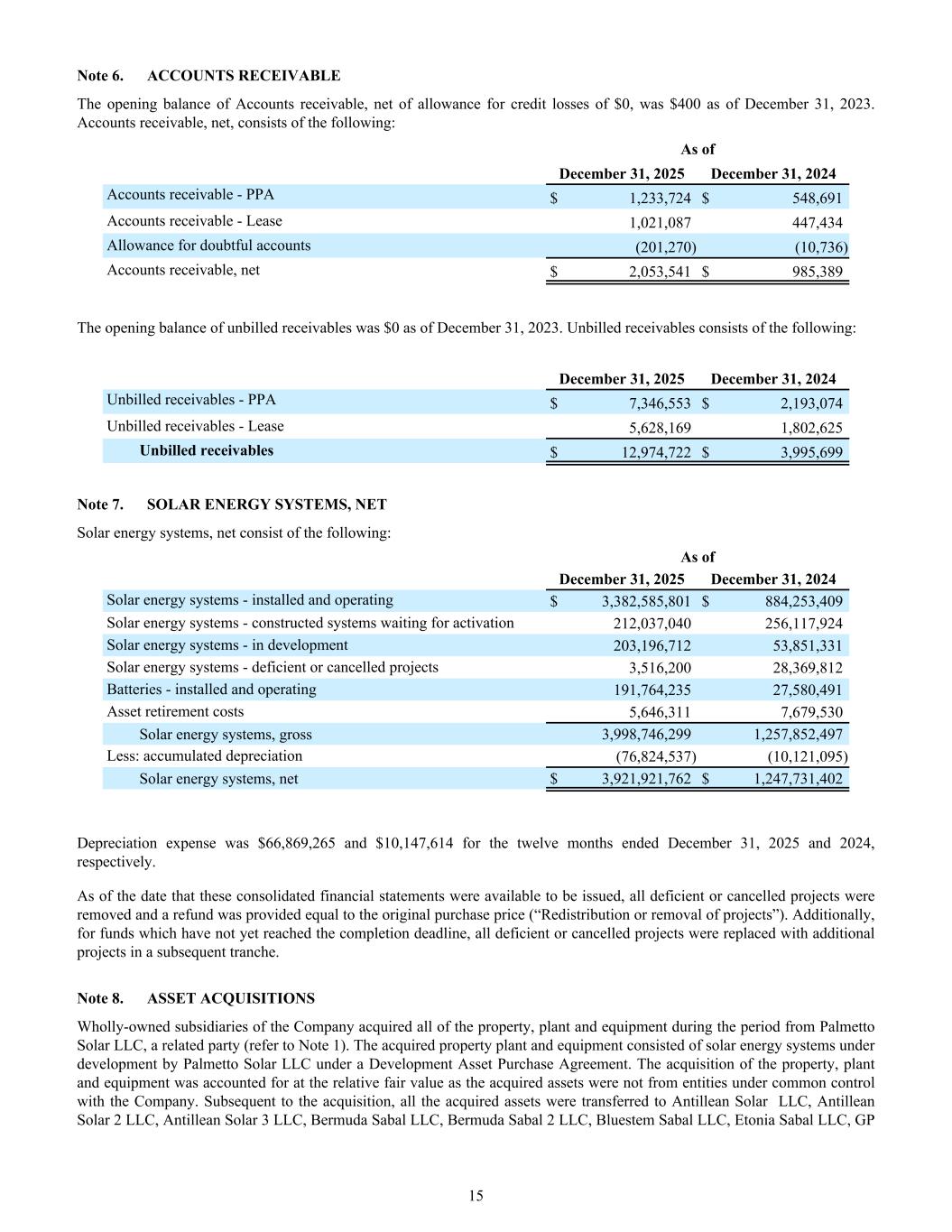
Note 6. ACCOUNTS RECEIVABLE The opening balance of Accounts receivable, net of allowance for credit losses of $0, was $400 as of December 31, 2023. Accounts receivable, net, consists of the following: As of December 31, 2025 December 31, 2024 Accounts receivable - PPA $ 1,233,724 $ 548,691 Accounts receivable - Lease 1,021,087 447,434 Allowance for doubtful accounts (201,270) (10,736) Accounts receivable, net $ 2,053,541 $ 985,389 The opening balance of unbilled receivables was $0 as of December 31, 2023. Unbilled receivables consists of the following: December 31, 2025 December 31, 2024 Unbilled receivables - PPA $ 7,346,553 $ 2,193,074 Unbilled receivables - Lease 5,628,169 1,802,625 Unbilled receivables $ 12,974,722 $ 3,995,699 Note 7. SOLAR ENERGY SYSTEMS, NET Solar energy systems, net consist of the following: As of December 31, 2025 December 31, 2024 Solar energy systems - installed and operating $ 3,382,585,801 $ 884,253,409 Solar energy systems - constructed systems waiting for activation 212,037,040 256,117,924 Solar energy systems - in development 203,196,712 53,851,331 Solar energy systems - deficient or cancelled projects 3,516,200 28,369,812 Batteries - installed and operating 191,764,235 27,580,491 Asset retirement costs 5,646,311 7,679,530 Solar energy systems, gross 3,998,746,299 1,257,852,497 Less: accumulated depreciation (76,824,537) (10,121,095) Solar energy systems, net $ 3,921,921,762 $ 1,247,731,402 Depreciation expense was $66,869,265 and $10,147,614 for the twelve months ended December 31, 2025 and 2024, respectively. As of the date that these consolidated financial statements were available to be issued, all deficient or cancelled projects were removed and a refund was provided equal to the original purchase price (“Redistribution or removal of projects”). Additionally, for funds which have not yet reached the completion deadline, all deficient or cancelled projects were replaced with additional projects in a subsequent tranche. Note 8. ASSET ACQUISITIONS Wholly-owned subsidiaries of the Company acquired all of the property, plant and equipment during the period from Palmetto Solar LLC, a related party (refer to Note 1). The acquired property plant and equipment consisted of solar energy systems under development by Palmetto Solar LLC under a Development Asset Purchase Agreement. The acquisition of the property, plant and equipment was accounted for at the relative fair value as the acquired assets were not from entities under common control with the Company. Subsequent to the acquisition, all the acquired assets were transferred to Antillean Solar LLC, Antillean Solar 2 LLC, Antillean Solar 3 LLC, Bermuda Sabal LLC, Bermuda Sabal 2 LLC, Bluestem Sabal LLC, Etonia Sabal LLC, GP 15
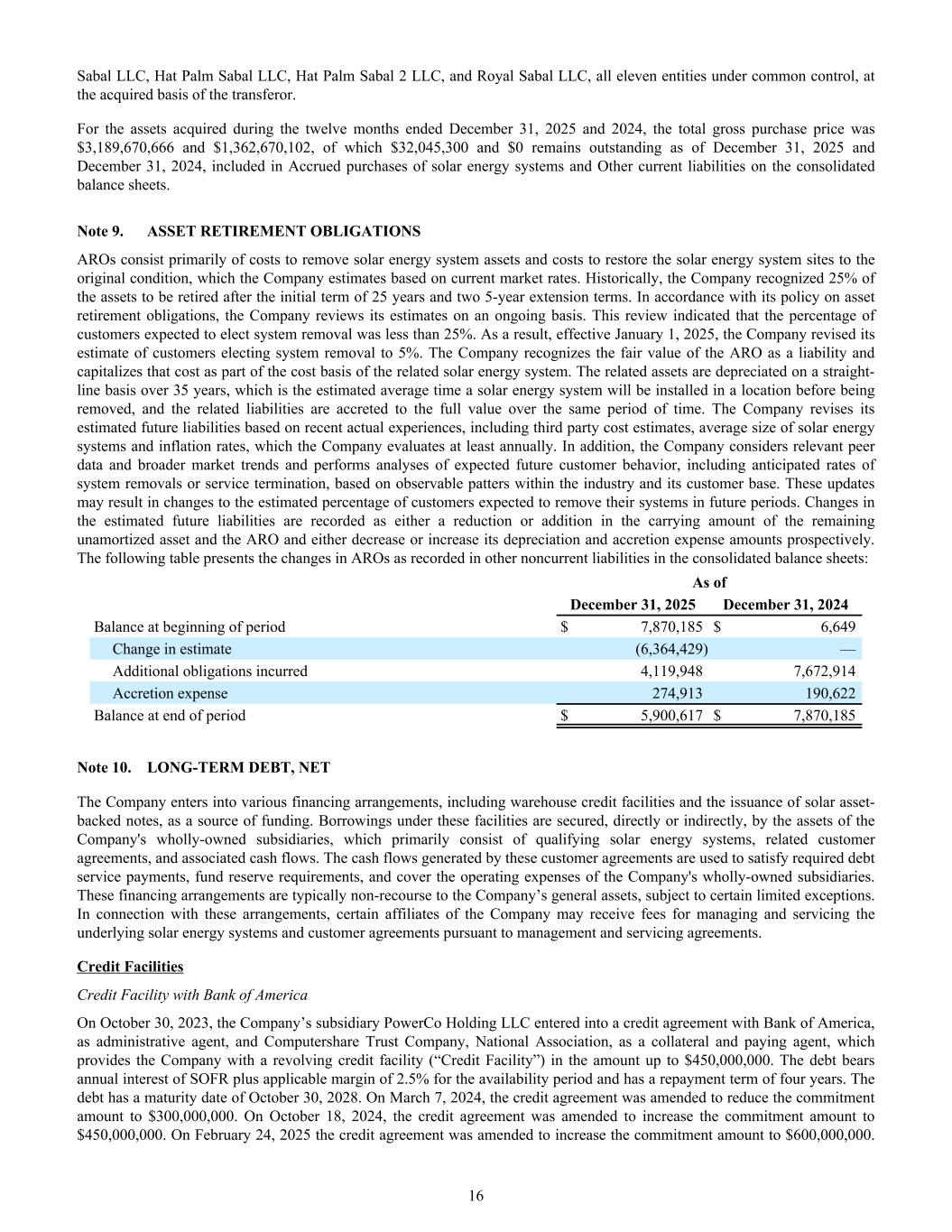
Sabal LLC, Hat Palm Sabal LLC, Hat Palm Sabal 2 LLC, and Royal Sabal LLC, all eleven entities under common control, at the acquired basis of the transferor. For the assets acquired during the twelve months ended December 31, 2025 and 2024, the total gross purchase price was $3,189,670,666 and $1,362,670,102, of which $32,045,300 and $0 remains outstanding as of December 31, 2025 and December 31, 2024, included in Accrued purchases of solar energy systems and Other current liabilities on the consolidated balance sheets. Note 9. ASSET RETIREMENT OBLIGATIONS AROs consist primarily of costs to remove solar energy system assets and costs to restore the solar energy system sites to the original condition, which the Company estimates based on current market rates. Historically, the Company recognized 25% of the assets to be retired after the initial term of 25 years and two 5-year extension terms. In accordance with its policy on asset retirement obligations, the Company reviews its estimates on an ongoing basis. This review indicated that the percentage of customers expected to elect system removal was less than 25%. As a result, effective January 1, 2025, the Company revised its estimate of customers electing system removal to 5%. The Company recognizes the fair value of the ARO as a liability and capitalizes that cost as part of the cost basis of the related solar energy system. The related assets are depreciated on a straight- line basis over 35 years, which is the estimated average time a solar energy system will be installed in a location before being removed, and the related liabilities are accreted to the full value over the same period of time. The Company revises its estimated future liabilities based on recent actual experiences, including third party cost estimates, average size of solar energy systems and inflation rates, which the Company evaluates at least annually. In addition, the Company considers relevant peer data and broader market trends and performs analyses of expected future customer behavior, including anticipated rates of system removals or service termination, based on observable patters within the industry and its customer base. These updates may result in changes to the estimated percentage of customers expected to remove their systems in future periods. Changes in the estimated future liabilities are recorded as either a reduction or addition in the carrying amount of the remaining unamortized asset and the ARO and either decrease or increase its depreciation and accretion expense amounts prospectively. The following table presents the changes in AROs as recorded in other noncurrent liabilities in the consolidated balance sheets: As of December 31, 2025 December 31, 2024 Balance at beginning of period $ 7,870,185 $ 6,649 Change in estimate (6,364,429) — Additional obligations incurred 4,119,948 7,672,914 Accretion expense 274,913 190,622 Balance at end of period $ 5,900,617 $ 7,870,185 Note 10. LONG-TERM DEBT, NET The Company enters into various financing arrangements, including warehouse credit facilities and the issuance of solar asset- backed notes, as a source of funding. Borrowings under these facilities are secured, directly or indirectly, by the assets of the Company's wholly-owned subsidiaries, which primarily consist of qualifying solar energy systems, related customer agreements, and associated cash flows. The cash flows generated by these customer agreements are used to satisfy required debt service payments, fund reserve requirements, and cover the operating expenses of the Company's wholly-owned subsidiaries. These financing arrangements are typically non-recourse to the Company’s general assets, subject to certain limited exceptions. In connection with these arrangements, certain affiliates of the Company may receive fees for managing and servicing the underlying solar energy systems and customer agreements pursuant to management and servicing agreements. Credit Facilities Credit Facility with Bank of America On October 30, 2023, the Company’s subsidiary PowerCo Holding LLC entered into a credit agreement with Bank of America, as administrative agent, and Computershare Trust Company, National Association, as a collateral and paying agent, which provides the Company with a revolving credit facility (“Credit Facility”) in the amount up to $450,000,000. The debt bears annual interest of SOFR plus applicable margin of 2.5% for the availability period and has a repayment term of four years. The debt has a maturity date of October 30, 2028. On March 7, 2024, the credit agreement was amended to reduce the commitment amount to $300,000,000. On October 18, 2024, the credit agreement was amended to increase the commitment amount to $450,000,000. On February 24, 2025 the credit agreement was amended to increase the commitment amount to $600,000,000. 16
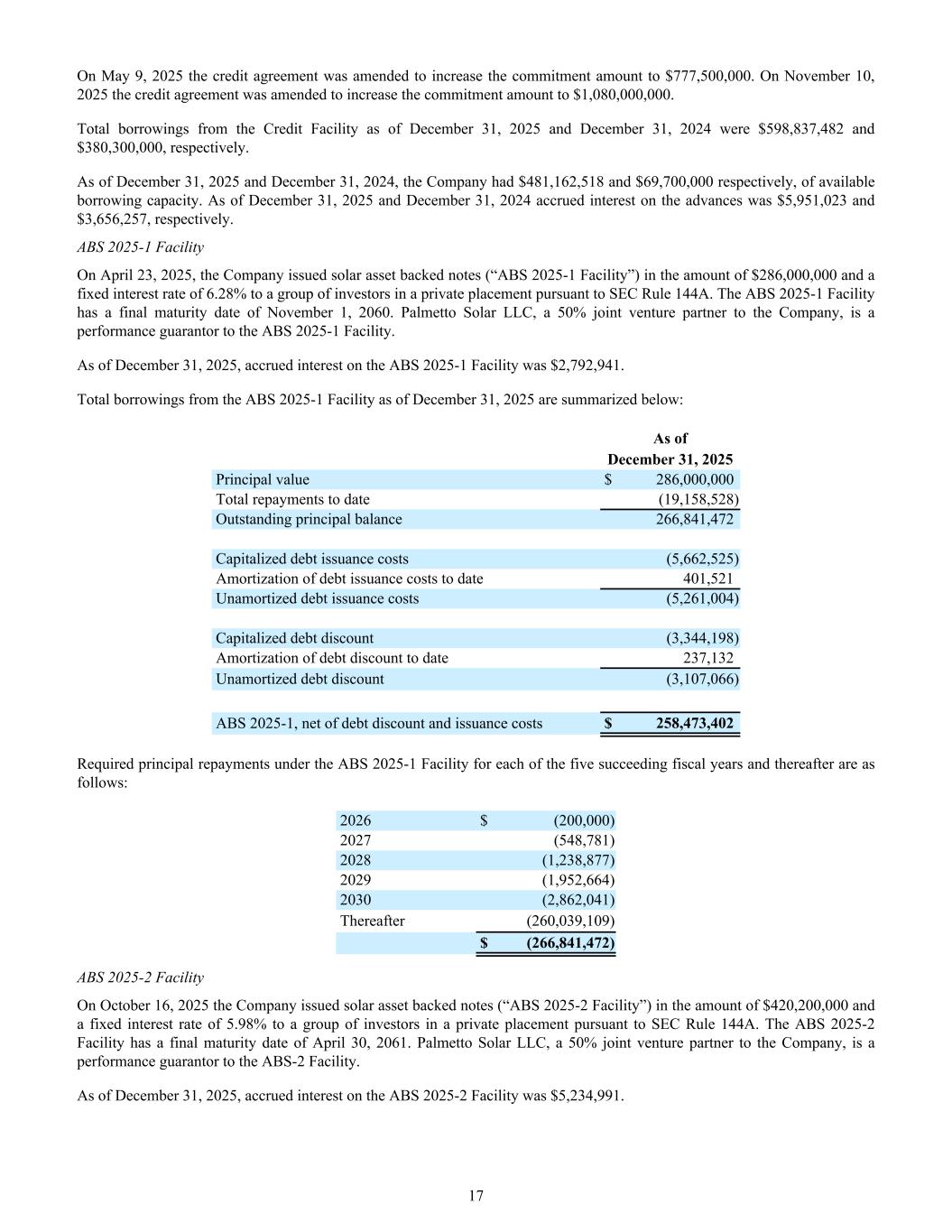
On May 9, 2025 the credit agreement was amended to increase the commitment amount to $777,500,000. On November 10, 2025 the credit agreement was amended to increase the commitment amount to $1,080,000,000. Total borrowings from the Credit Facility as of December 31, 2025 and December 31, 2024 were $598,837,482 and $380,300,000, respectively. As of December 31, 2025 and December 31, 2024, the Company had $481,162,518 and $69,700,000 respectively, of available borrowing capacity. As of December 31, 2025 and December 31, 2024 accrued interest on the advances was $5,951,023 and $3,656,257, respectively. ABS 2025-1 Facility On April 23, 2025, the Company issued solar asset backed notes (“ABS 2025-1 Facility”) in the amount of $286,000,000 and a fixed interest rate of 6.28% to a group of investors in a private placement pursuant to SEC Rule 144A. The ABS 2025-1 Facility has a final maturity date of November 1, 2060. Palmetto Solar LLC, a 50% joint venture partner to the Company, is a performance guarantor to the ABS 2025-1 Facility. As of December 31, 2025, accrued interest on the ABS 2025-1 Facility was $2,792,941. Total borrowings from the ABS 2025-1 Facility as of December 31, 2025 are summarized below: As of December 31, 2025 Principal value $ 286,000,000 Total repayments to date (19,158,528) Outstanding principal balance 266,841,472 Capitalized debt issuance costs (5,662,525) Amortization of debt issuance costs to date 401,521 Unamortized debt issuance costs (5,261,004) Capitalized debt discount (3,344,198) Amortization of debt discount to date 237,132 Unamortized debt discount (3,107,066) ABS 2025-1, net of debt discount and issuance costs $ 258,473,402 Required principal repayments under the ABS 2025-1 Facility for each of the five succeeding fiscal years and thereafter are as follows: 2026 $ (200,000) 2027 (548,781) 2028 (1,238,877) 2029 (1,952,664) 2030 (2,862,041) Thereafter (260,039,109) $ (266,841,472) ABS 2025-2 Facility On October 16, 2025 the Company issued solar asset backed notes (“ABS 2025-2 Facility”) in the amount of $420,200,000 and a fixed interest rate of 5.98% to a group of investors in a private placement pursuant to SEC Rule 144A. The ABS 2025-2 Facility has a final maturity date of April 30, 2061. Palmetto Solar LLC, a 50% joint venture partner to the Company, is a performance guarantor to the ABS-2 Facility. As of December 31, 2025, accrued interest on the ABS 2025-2 Facility was $5,234,991. 17
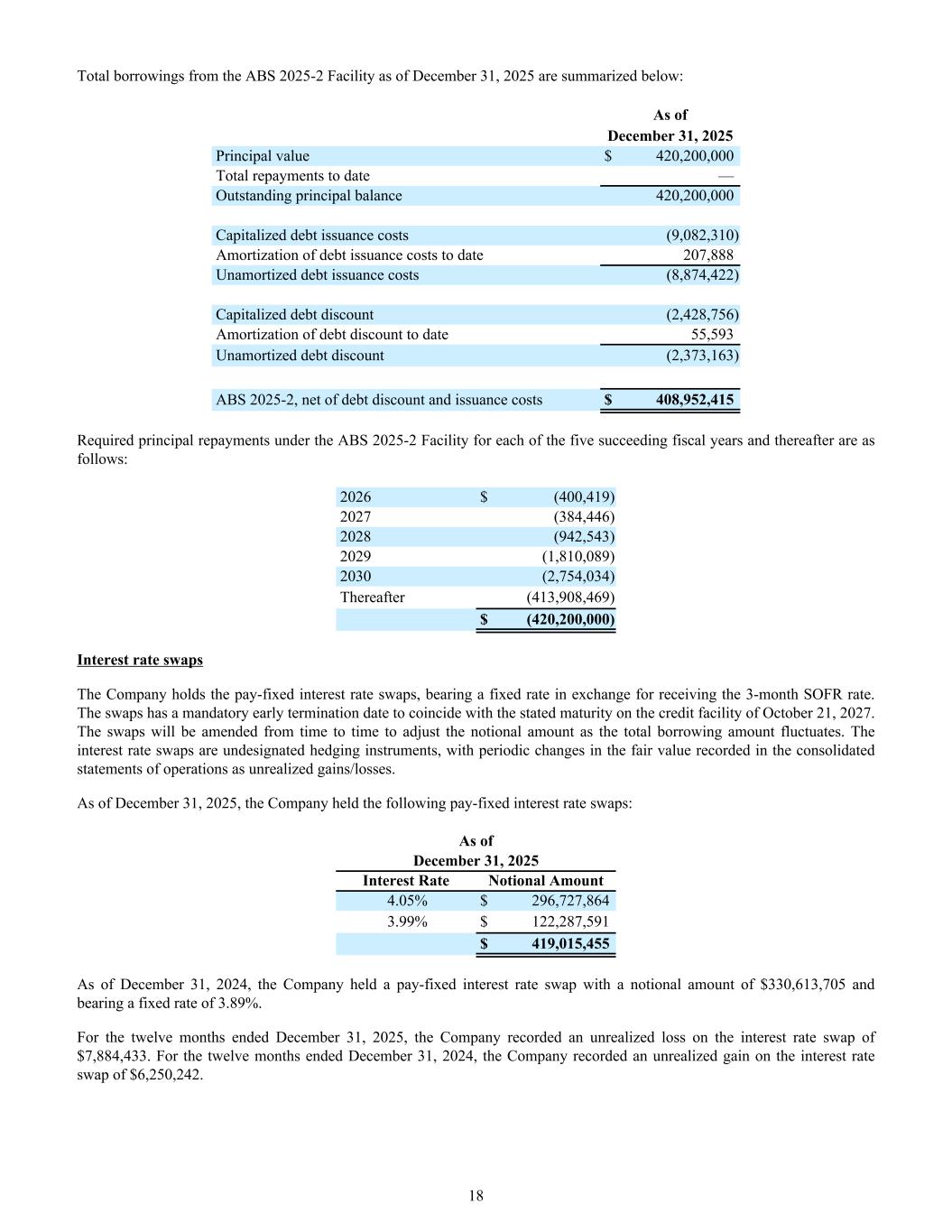
Total borrowings from the ABS 2025-2 Facility as of December 31, 2025 are summarized below: As of December 31, 2025 Principal value $ 420,200,000 Total repayments to date — Outstanding principal balance 420,200,000 Capitalized debt issuance costs (9,082,310) Amortization of debt issuance costs to date 207,888 Unamortized debt issuance costs (8,874,422) Capitalized debt discount (2,428,756) Amortization of debt discount to date 55,593 Unamortized debt discount (2,373,163) ABS 2025-2, net of debt discount and issuance costs $ 408,952,415 Required principal repayments under the ABS 2025-2 Facility for each of the five succeeding fiscal years and thereafter are as follows: 2026 $ (400,419) 2027 (384,446) 2028 (942,543) 2029 (1,810,089) 2030 (2,754,034) Thereafter (413,908,469) $ (420,200,000) Interest rate swaps The Company holds the pay-fixed interest rate swaps, bearing a fixed rate in exchange for receiving the 3-month SOFR rate. The swaps has a mandatory early termination date to coincide with the stated maturity on the credit facility of October 21, 2027. The swaps will be amended from time to time to adjust the notional amount as the total borrowing amount fluctuates. The interest rate swaps are undesignated hedging instruments, with periodic changes in the fair value recorded in the consolidated statements of operations as unrealized gains/losses. As of December 31, 2025, the Company held the following pay-fixed interest rate swaps: As of December 31, 2025 Interest Rate Notional Amount 4.05% $ 296,727,864 3.99% $ 122,287,591 $ 419,015,455 As of December 31, 2024, the Company held a pay-fixed interest rate swap with a notional amount of $330,613,705 and bearing a fixed rate of 3.89%. For the twelve months ended December 31, 2025, the Company recorded an unrealized loss on the interest rate swap of $7,884,433. For the twelve months ended December 31, 2024, the Company recorded an unrealized gain on the interest rate swap of $6,250,242. 18
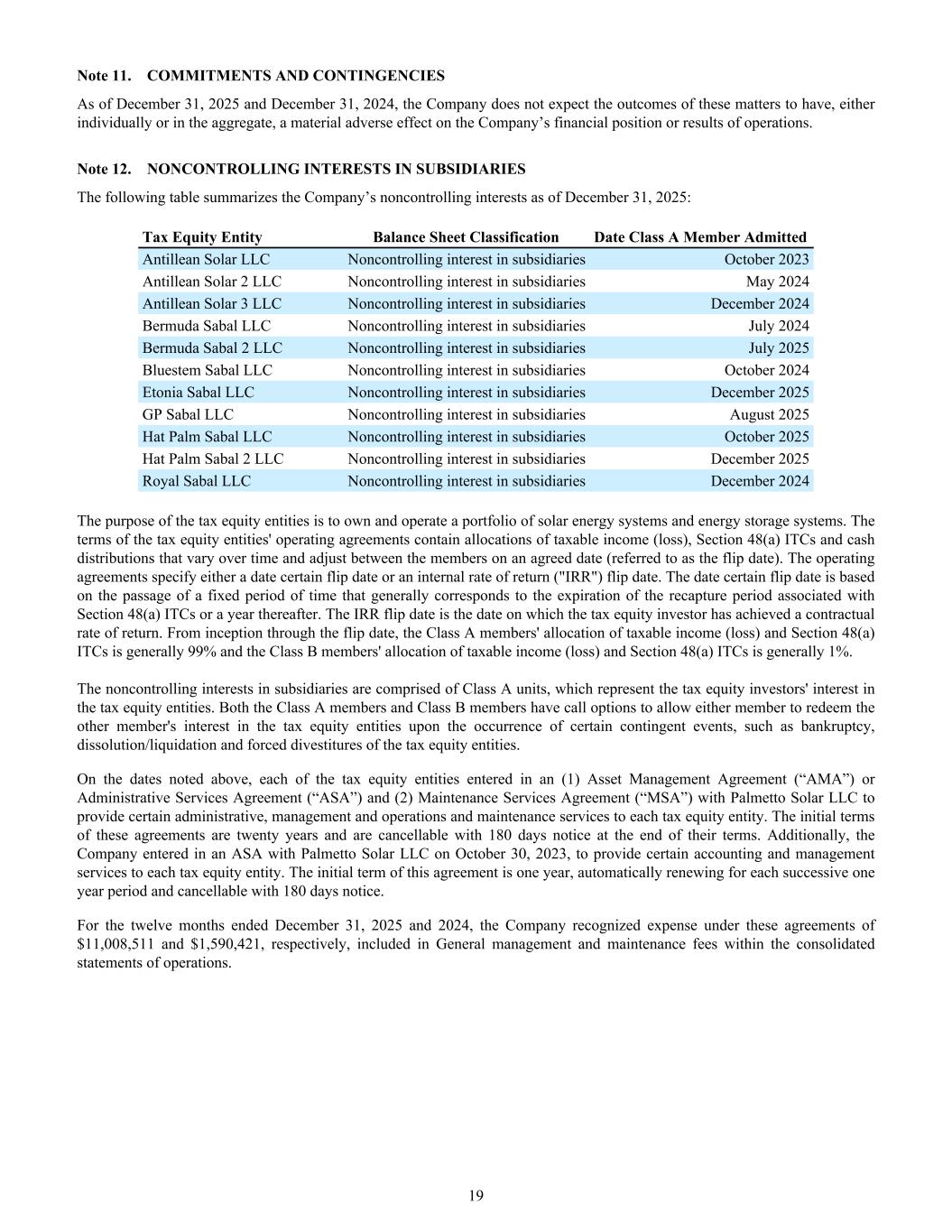
Note 11. COMMITMENTS AND CONTINGENCIES As of December 31, 2025 and December 31, 2024, the Company does not expect the outcomes of these matters to have, either individually or in the aggregate, a material adverse effect on the Company’s financial position or results of operations. Note 12. NONCONTROLLING INTERESTS IN SUBSIDIARIES The following table summarizes the Company’s noncontrolling interests as of December 31, 2025: Tax Equity Entity Balance Sheet Classification Date Class A Member Admitted Antillean Solar LLC Noncontrolling interest in subsidiaries October 2023 Antillean Solar 2 LLC Noncontrolling interest in subsidiaries May 2024 Antillean Solar 3 LLC Noncontrolling interest in subsidiaries December 2024 Bermuda Sabal LLC Noncontrolling interest in subsidiaries July 2024 Bermuda Sabal 2 LLC Noncontrolling interest in subsidiaries July 2025 Bluestem Sabal LLC Noncontrolling interest in subsidiaries October 2024 Etonia Sabal LLC Noncontrolling interest in subsidiaries December 2025 GP Sabal LLC Noncontrolling interest in subsidiaries August 2025 Hat Palm Sabal LLC Noncontrolling interest in subsidiaries October 2025 Hat Palm Sabal 2 LLC Noncontrolling interest in subsidiaries December 2025 Royal Sabal LLC Noncontrolling interest in subsidiaries December 2024 The purpose of the tax equity entities is to own and operate a portfolio of solar energy systems and energy storage systems. The terms of the tax equity entities' operating agreements contain allocations of taxable income (loss), Section 48(a) ITCs and cash distributions that vary over time and adjust between the members on an agreed date (referred to as the flip date). The operating agreements specify either a date certain flip date or an internal rate of return ("IRR") flip date. The date certain flip date is based on the passage of a fixed period of time that generally corresponds to the expiration of the recapture period associated with Section 48(a) ITCs or a year thereafter. The IRR flip date is the date on which the tax equity investor has achieved a contractual rate of return. From inception through the flip date, the Class A members' allocation of taxable income (loss) and Section 48(a) ITCs is generally 99% and the Class B members' allocation of taxable income (loss) and Section 48(a) ITCs is generally 1%. The noncontrolling interests in subsidiaries are comprised of Class A units, which represent the tax equity investors' interest in the tax equity entities. Both the Class A members and Class B members have call options to allow either member to redeem the other member's interest in the tax equity entities upon the occurrence of certain contingent events, such as bankruptcy, dissolution/liquidation and forced divestitures of the tax equity entities. On the dates noted above, each of the tax equity entities entered in an (1) Asset Management Agreement (“AMA”) or Administrative Services Agreement (“ASA”) and (2) Maintenance Services Agreement (“MSA”) with Palmetto Solar LLC to provide certain administrative, management and operations and maintenance services to each tax equity entity. The initial terms of these agreements are twenty years and are cancellable with 180 days notice at the end of their terms. Additionally, the Company entered in an ASA with Palmetto Solar LLC on October 30, 2023, to provide certain accounting and management services to each tax equity entity. The initial term of this agreement is one year, automatically renewing for each successive one year period and cancellable with 180 days notice. For the twelve months ended December 31, 2025 and 2024, the Company recognized expense under these agreements of $11,008,511 and $1,590,421, respectively, included in General management and maintenance fees within the consolidated statements of operations. 19
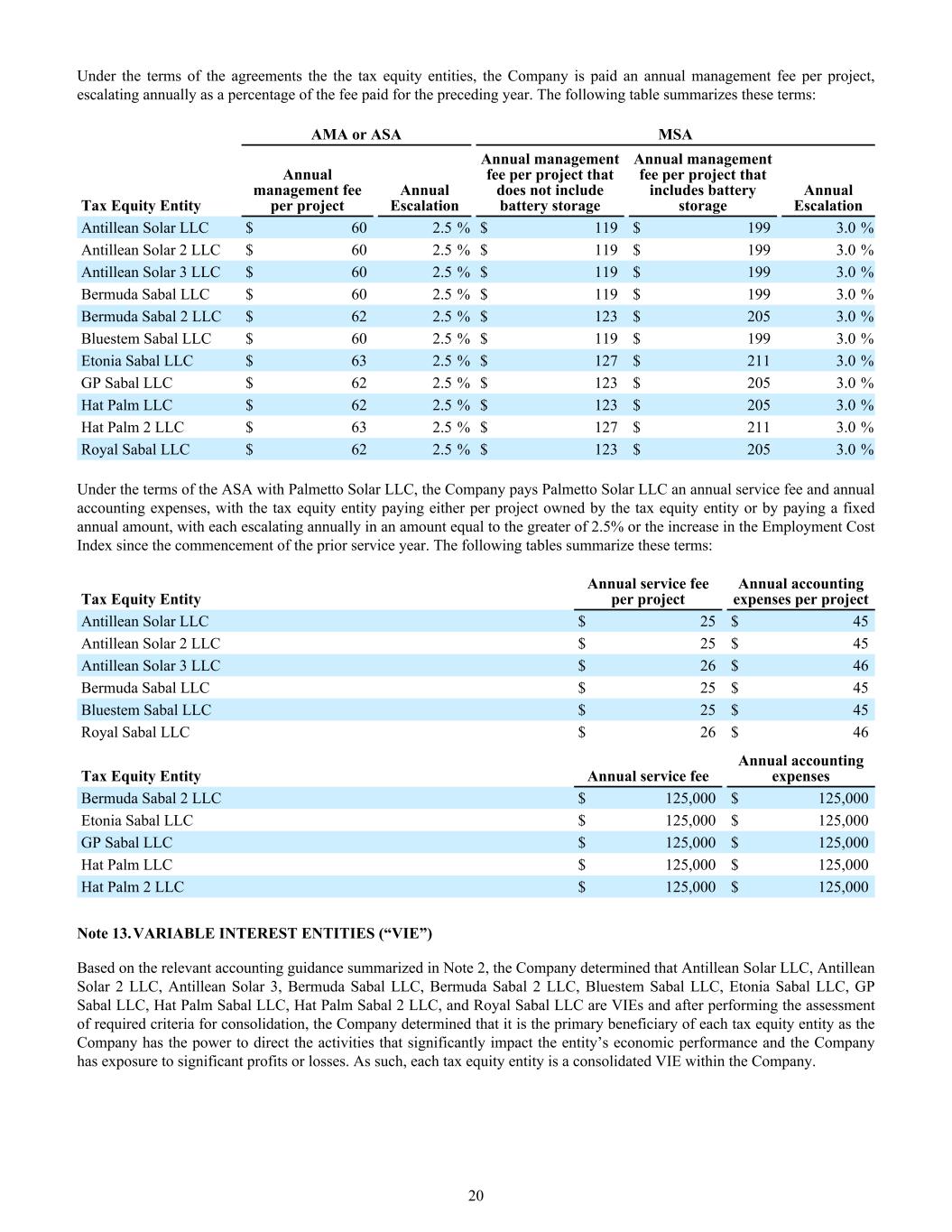
Under the terms of the agreements the the tax equity entities, the Company is paid an annual management fee per project, escalating annually as a percentage of the fee paid for the preceding year. The following table summarizes these terms: AMA or ASA MSA Tax Equity Entity Annual management fee per project Annual Escalation Annual management fee per project that does not include battery storage Annual management fee per project that includes battery storage Annual Escalation Antillean Solar LLC $ 60 2.5 % $ 119 $ 199 3.0 % Antillean Solar 2 LLC $ 60 2.5 % $ 119 $ 199 3.0 % Antillean Solar 3 LLC $ 60 2.5 % $ 119 $ 199 3.0 % Bermuda Sabal LLC $ 60 2.5 % $ 119 $ 199 3.0 % Bermuda Sabal 2 LLC $ 62 2.5 % $ 123 $ 205 3.0 % Bluestem Sabal LLC $ 60 2.5 % $ 119 $ 199 3.0 % Etonia Sabal LLC $ 63 2.5 % $ 127 $ 211 3.0 % GP Sabal LLC $ 62 2.5 % $ 123 $ 205 3.0 % Hat Palm LLC $ 62 2.5 % $ 123 $ 205 3.0 % Hat Palm 2 LLC $ 63 2.5 % $ 127 $ 211 3.0 % Royal Sabal LLC $ 62 2.5 % $ 123 $ 205 3.0 % Under the terms of the ASA with Palmetto Solar LLC, the Company pays Palmetto Solar LLC an annual service fee and annual accounting expenses, with the tax equity entity paying either per project owned by the tax equity entity or by paying a fixed annual amount, with each escalating annually in an amount equal to the greater of 2.5% or the increase in the Employment Cost Index since the commencement of the prior service year. The following tables summarize these terms: Tax Equity Entity Annual service fee per project Annual accounting expenses per project Antillean Solar LLC $ 25 $ 45 Antillean Solar 2 LLC $ 25 $ 45 Antillean Solar 3 LLC $ 26 $ 46 Bermuda Sabal LLC $ 25 $ 45 Bluestem Sabal LLC $ 25 $ 45 Royal Sabal LLC $ 26 $ 46 Tax Equity Entity Annual service fee Annual accounting expenses Bermuda Sabal 2 LLC $ 125,000 $ 125,000 Etonia Sabal LLC $ 125,000 $ 125,000 GP Sabal LLC $ 125,000 $ 125,000 Hat Palm LLC $ 125,000 $ 125,000 Hat Palm 2 LLC $ 125,000 $ 125,000 Note 13. VARIABLE INTEREST ENTITIES (“VIE”) Based on the relevant accounting guidance summarized in Note 2, the Company determined that Antillean Solar LLC, Antillean Solar 2 LLC, Antillean Solar 3, Bermuda Sabal LLC, Bermuda Sabal 2 LLC, Bluestem Sabal LLC, Etonia Sabal LLC, GP Sabal LLC, Hat Palm Sabal LLC, Hat Palm Sabal 2 LLC, and Royal Sabal LLC are VIEs and after performing the assessment of required criteria for consolidation, the Company determined that it is the primary beneficiary of each tax equity entity as the Company has the power to direct the activities that significantly impact the entity’s economic performance and the Company has exposure to significant profits or losses. As such, each tax equity entity is a consolidated VIE within the Company. 20
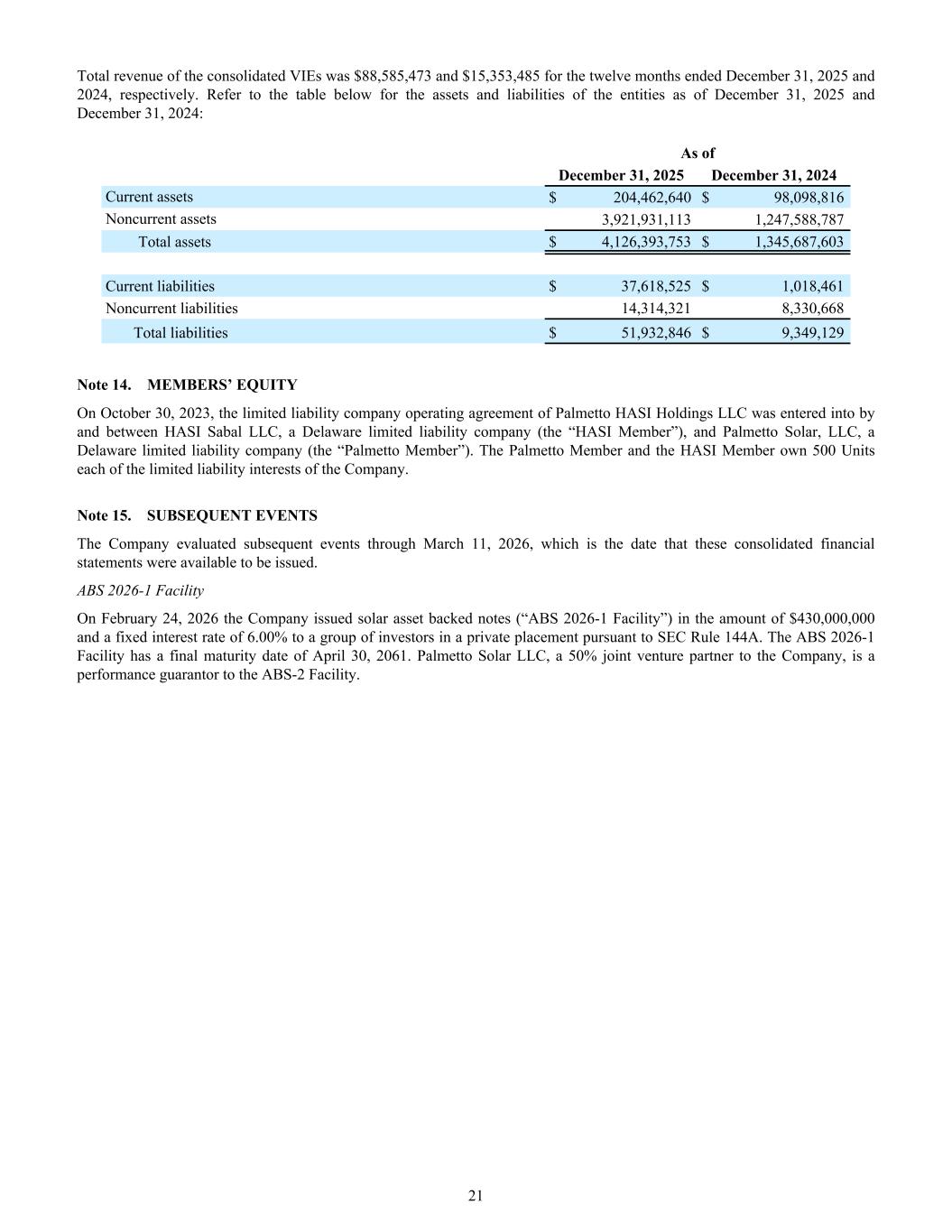
Total revenue of the consolidated VIEs was $88,585,473 and $15,353,485 for the twelve months ended December 31, 2025 and 2024, respectively. Refer to the table below for the assets and liabilities of the entities as of December 31, 2025 and December 31, 2024: As of December 31, 2025 December 31, 2024 Current assets $ 204,462,640 $ 98,098,816 Noncurrent assets 3,921,931,113 1,247,588,787 Total assets $ 4,126,393,753 $ 1,345,687,603 Current liabilities $ 37,618,525 $ 1,018,461 Noncurrent liabilities 14,314,321 8,330,668 Total liabilities $ 51,932,846 $ 9,349,129 Note 14. MEMBERS’ EQUITY On October 30, 2023, the limited liability company operating agreement of Palmetto HASI Holdings LLC was entered into by and between HASI Sabal LLC, a Delaware limited liability company (the “HASI Member”), and Palmetto Solar, LLC, a Delaware limited liability company (the “Palmetto Member”). The Palmetto Member and the HASI Member own 500 Units each of the limited liability interests of the Company. Note 15. SUBSEQUENT EVENTS The Company evaluated subsequent events through March 11, 2026, which is the date that these consolidated financial statements were available to be issued. ABS 2026-1 Facility On February 24, 2026 the Company issued solar asset backed notes (“ABS 2026-1 Facility”) in the amount of $430,000,000 and a fixed interest rate of 6.00% to a group of investors in a private placement pursuant to SEC Rule 144A. The ABS 2026-1 Facility has a final maturity date of April 30, 2061. Palmetto Solar LLC, a 50% joint venture partner to the Company, is a performance guarantor to the ABS-2 Facility. 21